

Two paintings by the late Florida Highwaymen artist Al Black hang on the wall of my bedroom. I purchased them years ago after having the opportunity to meet him, and although I’ve collected and admired different kinds of art throughout my life, these two paintings have always been particularly special to me. I eventually had them reframed, wanting to give them a presentation that reflected both my appreciation for the artwork and my admiration for the man who created it.
I enjoy looking at them, not simply because of the landscapes they depict, but because I know something about the extraordinary history behind them. Their colors, trees, water, and skies reflect a vision of Florida that has become increasingly difficult to find. More importantly, they represent an artistic movement that emerged under circumstances in which opportunity was limited, racial segregation was enforced, and talent alone did not guarantee access to the galleries and institutions that traditionally determined whose work deserved recognition.
Meeting Al Black gave that history a personal dimension. I have photographs of us together holding paintings, and another of him signing the back of one of the works. Those photographs have become treasured reminders of an encounter with someone who participated in one of the most unusual and important chapters of Florida’s artistic history.
Al died on May 12, 2025. When I learned of his passing, I found myself thinking again about our meeting and the paintings that remain part of my everyday life. The circumstances that produced the Florida Highwaymen are now decades behind us, and most of the original artists are no longer living. Yet their work continues to attract collectors, inspire younger painters, and receive the recognition that was largely unavailable to them when they began.
As someone who studied history at the University of South Florida and has spent much of my adult life photographing and documenting places, I find their story fascinating. It brings together subjects that have always interested me: Florida’s changing landscape, the relationship between art and history, and the experiences of individuals who found ways to create opportunities when the established institutions of their time would not welcome them.
The more I learn about the Highwaymen, the more I appreciate that their achievement cannot be explained simply by the beauty of their paintings. Their history is inseparable from the social and economic conditions of the Florida in which they lived.
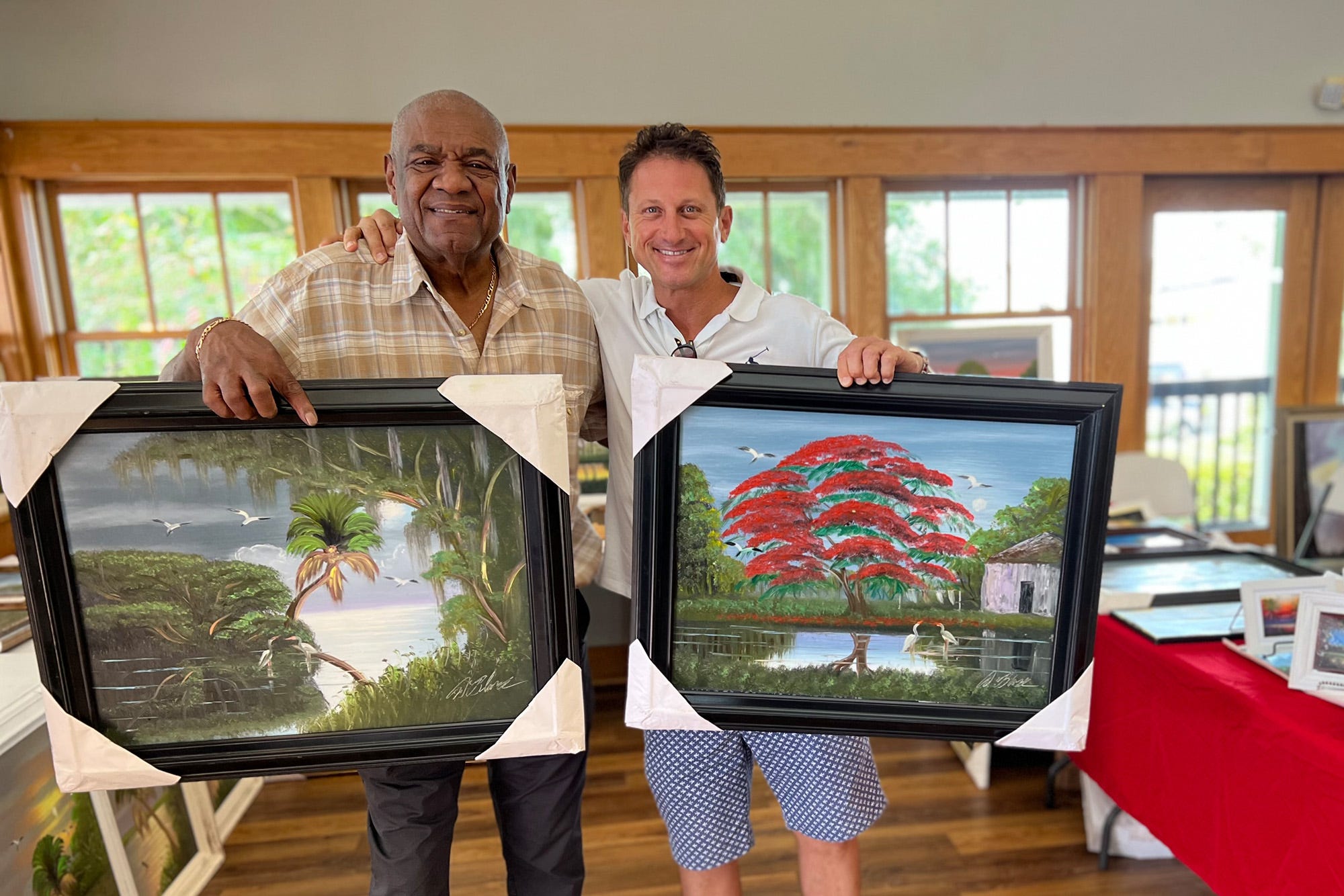
Mark A. Middleton with Florida Highwaymen artist Al Black. This personal meeting remains one of my most meaningful connections to the history of Florida landscape painting. Photograph from the author’s collection.
An Artistic Movement Born in Fort Pierce
The Florida Highwaymen emerged during the 1950s in and around Fort Pierce, a coastal community along Florida’s Indian River Lagoon. The region’s waterways, citrus groves, beaches, and subtropical vegetation provided subjects that would become familiar to generations of collectors.
At the time, much of Florida was undergoing a tremendous transformation. The years following World War II brought expanding highways, new residential developments, rising tourism, and population growth that would permanently change the state’s geography. The open landscapes of an earlier Florida, with their undeveloped coastlines, wetlands, and vast stretches of native vegetation, were gradually giving way to subdivisions, commercial districts, and modern infrastructure.
For young Black artists in Fort Pierce, the opportunity to depict that landscape emerged amid the realities of the segregated South. Artistic institutions and commercial galleries were not equally available to Black painters. Employment opportunities were also restricted, and many African Americans found themselves working in agricultural fields, factories, or other labor-intensive occupations offering relatively little economic mobility.
Two artists became particularly important in the movement’s beginnings: Harold Newton and Alfred Hair.
Newton, born in 1934, developed an interest in painting at an early age. His work became known for its attention to the Florida landscape, particularly the water, vegetation, and atmospheric qualities of the Treasure Coast. His influence would extend to other young painters, including Mary Ann Carroll, whose artistic career began after observing him at work.
Alfred Hair, born in 1941, was another extraordinary talent. His artistic education was encouraged by Zanobia Jefferson, a teacher at Fort Pierce’s Lincoln Park Academy, who helped connect him with established Florida landscape painter A.E. “Bean” Backus.
Backus, a white artist whose reputation rested on his sensitive portrayals of Florida scenery, became an important mentor during a period when relationships across racial boundaries were constrained by segregation. His influence helped introduce Hair to the techniques and possibilities of landscape painting, but Hair would develop an approach that was unmistakably his own.
Rather than pursue a conventional artistic career through galleries, Hair recognized an opportunity to produce appealing landscape paintings and sell them directly to buyers. He worked quickly, experimented with inexpensive materials, and developed methods that allowed paintings to be produced and distributed in considerable numbers.
His approach attracted other painters who learned from his example, shared techniques, and began producing their own interpretations of Florida scenery.
What emerged was not a formal school with a written philosophy or prescribed membership. The artists were connected by geography, circumstances, personal relationships, and a shared understanding that painting could offer a livelihood.
The works themselves varied considerably. Some artists developed subtle atmospheric effects and carefully observed natural details, while others favored vivid colors, dramatic skies, and bolder, more spontaneous compositions. Their paintings were linked by common subjects and working methods, but each artist brought a distinct personality to the canvas.
That individuality is one reason the Florida Highwaymen deserve to be considered as artists rather than simply as participants in an interesting historical episode.
Their story is remarkable, but so is the work.
Selling Art on the Highway
The name “Florida Highwaymen” is now so familiar that it is easy to assume the artists called themselves that from the beginning. They did not.
During their most productive years, the painters were known primarily through personal relationships, individual reputations, and the businesses or customers who purchased their work. The Highwaymen name came much later, when art collector and gallery owner Jim Fitch began researching and writing about the artists in the mid-1990s.
The name referred to the unconventional manner in which many sold their paintings.
With established galleries largely inaccessible, the artists traveled Florida’s highways carrying completed and sometimes still-wet paintings in their automobiles. They approached hotels, offices, restaurants, businesses, and private customers, offering landscapes that were affordable to ordinary buyers.
A painting might sell for twenty or twenty-five dollars, sometimes a little more. For the buyer, it was an inexpensive decorative object portraying the beauty of Florida. For the artist, selling several paintings in a day could provide an income and a measure of independence that was otherwise difficult to obtain.
There was considerable ingenuity in their working methods.
Traditional stretched canvases could be expensive. The Highwaymen frequently used inexpensive building materials, including Upson board, Masonite, and other hardboard surfaces. Frames were often fashioned from wood molding or door trim. Paint was applied quickly, sometimes with palette knives or broad brushes, allowing artists to complete numerous landscapes in a relatively short period.
These materials and techniques were not simply signs of economic necessity. They became part of the visual character of the paintings.
The broad strokes and textured surfaces conveyed movement and atmosphere. Skies appeared luminous, trees seemed animated by coastal winds, and reflections on water were suggested with remarkable economy. Instead of carefully describing every leaf, branch, and ripple, the artists often captured the impression of a landscape through color, composition, and gesture.
Their work was accessible because it was affordable, but it also appealed to people because it portrayed a Florida they recognized or wished to remember.
Many of the paintings were produced from memory and imagination rather than direct observation of a particular location. A single scene might incorporate familiar elements of several places: a lagoon beneath a dramatic sky, a palm leaning over the water, an egret standing among the reeds, or a royal poinciana in full bloom.
The result was often an idealized landscape, but one rooted in the artists’ experience of Florida.
These were paintings of a state that was already beginning to disappear.
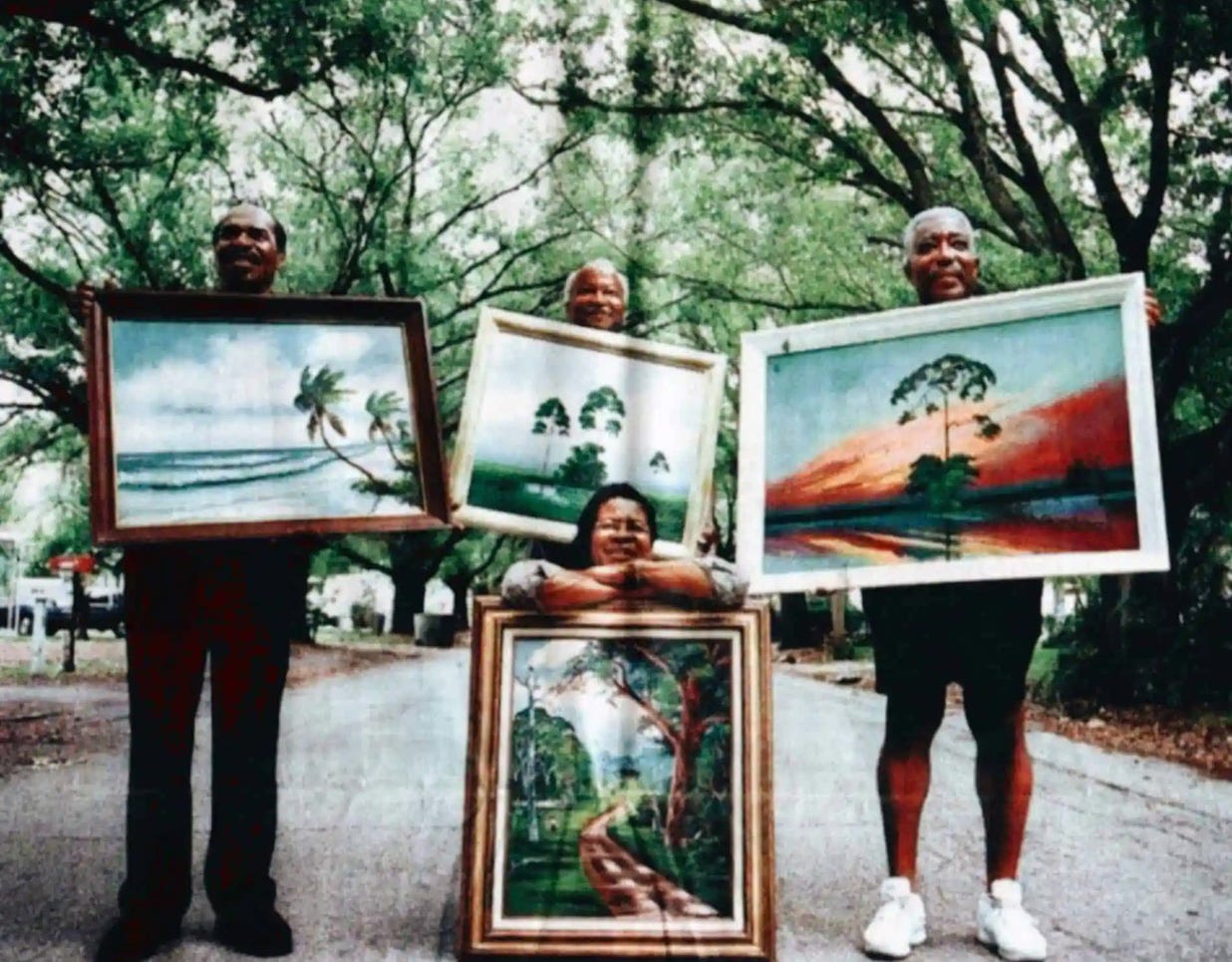
The Florida Highwaymen developed an independent market for their landscape paintings, traveling throughout the state to reach customers who might never have entered an art gallery. Archival photograph; photographer and source to be credited.
The scale of their achievement is remarkable. Estimates commonly suggest that the artists produced approximately 200,000 paintings during the movement’s principal years, an extraordinary number for a group whose members worked largely outside established artistic institutions.
Yet their success should not be romanticized as a simple story of artists who preferred the freedom of the open road. Their direct-sales methods were, in significant part, a response to discrimination. They developed an alternative marketplace because the conventional one was frequently closed to them.
That distinction is essential to understanding the Highwaymen’s history.
Painting the Florida We Remember
I have always been attracted to the Florida landscapes depicted by the Highwaymen, perhaps because so many of the subjects are familiar from my own photography and travels throughout the state.
Their paintings often portray a landscape that feels both recognizable and distant. The vegetation is unmistakably Floridian, the light has the quality of a Gulf or Atlantic Coast afternoon, and the rivers and lagoons reflect the subtropical environment. Yet there is often little evidence of the roads, residential development, commercial activity, and modern structures that have transformed much of Florida over the past seventy years.
The natural world dominates the composition.
Royal poinciana trees appear in brilliant red and orange, their spreading canopies contrasting with the cooler greens and blues surrounding them. Palms lean over quiet waterways, white egrets stand along the shoreline, and dramatic clouds rise above landscapes that seem almost untouched by human activity.
Some paintings are peaceful and restrained. Others are filled with extraordinary energy, their skies glowing with color and their brushwork conveying movement throughout the scene.
The beauty lies partly in what the artists choose not to include.
They reduce the landscape to its essential forms, allowing the viewer’s imagination to complete the picture.
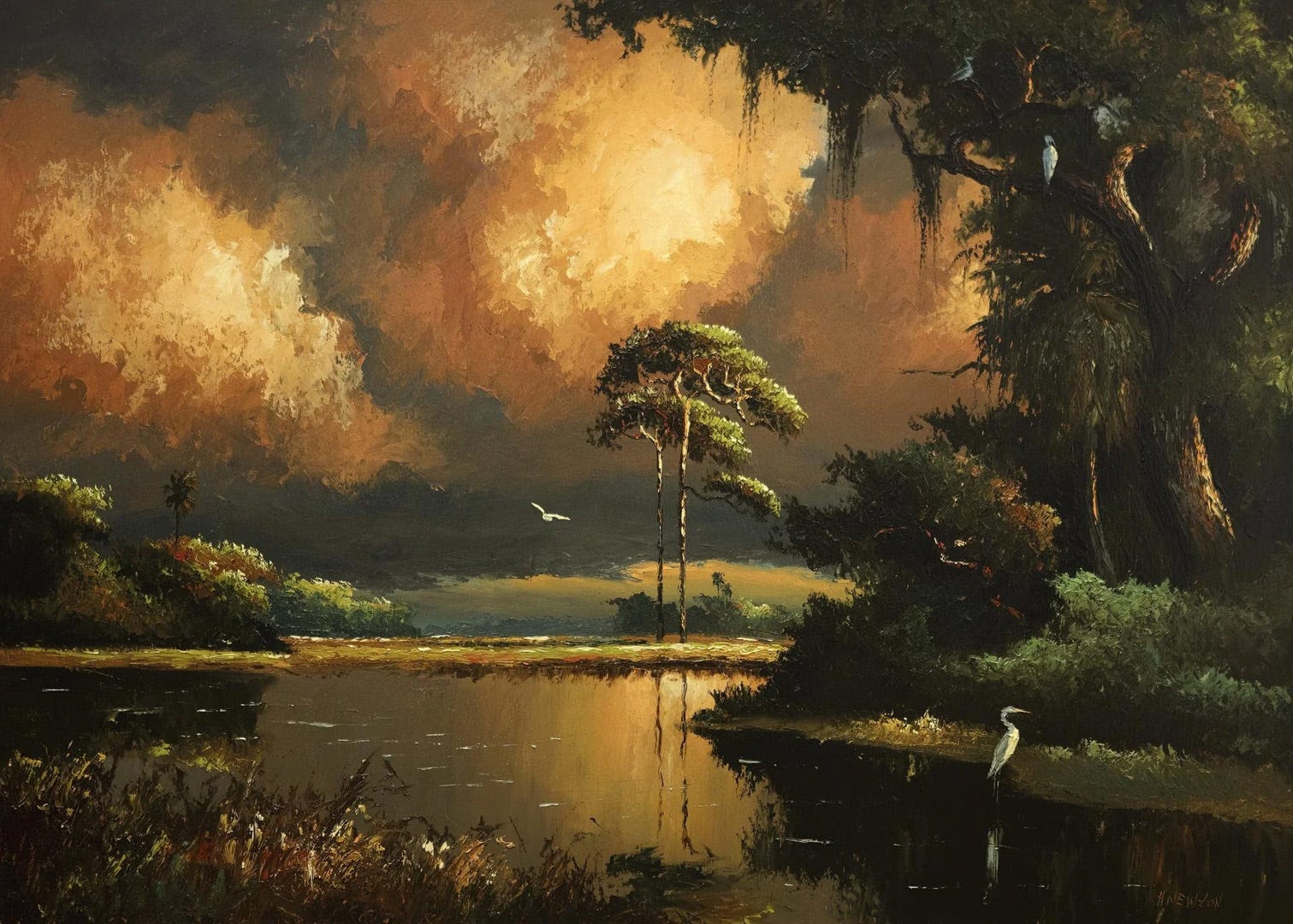
Florida landscape painting depicting a luminous sky above a quiet waterway, with native vegetation and wading birds.
As a photographer, I often find myself making similar decisions about composition. Where should the viewer’s attention be directed? How much of the surrounding landscape is necessary? What role does light play in establishing the mood of an image?
The Highwaymen answered those questions with paint rather than a camera, often using remarkably direct methods to create images that remain visually compelling decades later.
Their paintings are also important historical documents, although not in the conventional sense. They do not necessarily record specific places with geographic precision. Instead, they preserve the emotional and visual character of a Florida that existed in the memories and imaginations of the artists.
This distinction is particularly apparent in their portrayals of water.
The Indian River Lagoon, coastal inlets, marshes, and quiet inland waterways became recurring subjects. Water offered opportunities to depict reflection, atmosphere, changing light, and the relationship between the sky and the land.
A Florida sunset could become an arrangement of intense orange, gold, purple, and blue. A river scene could be reduced to a few carefully placed trees, reflections, and distant birds. These compositions evoke a sense of place without requiring a recognizable landmark.
For collectors, that quality can make the paintings unusually personal.
They may remind one person of a childhood spent near the Indian River, another of fishing trips along the Gulf Coast, and someone else of the rural Florida remembered from earlier generations.
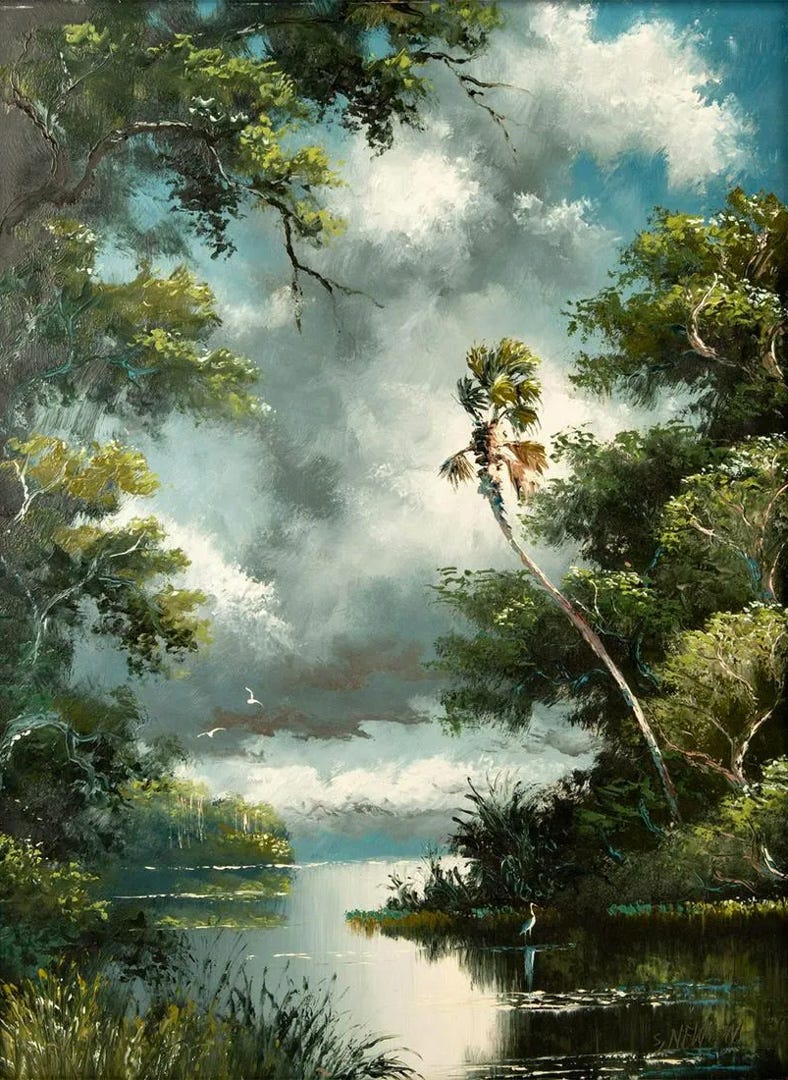
Palm trees and water birds appear frequently in Florida Highwaymen landscape painting, reflecting the natural subjects that distinguished the movement.
I think this connection to memory is one of the principal reasons the paintings have maintained their appeal. Florida has changed enormously, but these images preserve something of the state’s earlier atmosphere.
They offer a view of the landscape before much of it became the built environment we know today.
Al Black: The Salesman Who Became a Painter
Among the original Highwaymen, Al Black had one of the most unusual life stories.
Born in Mississippi, Black moved to Fort Pierce as a teenager and eventually became associated with Alfred Hair and the artists working around him. His early contribution was not primarily as a painter but as a salesman.
Black had a remarkable ability to approach prospective customers and persuade them to purchase artwork. He traveled extensively, sometimes selling dozens of paintings in a day, and became an important part of the commercial success of Hair’s operation.
His personality was as colorful as many of the landscapes he represented. Accounts of his life describe an outgoing, determined man who was willing to approach customers others might have avoided and who understood the value of persistence in sales.
Because the paintings were often transported before they had completely dried, they could be damaged during travel. Black learned to repair them, gradually developing the painting skills that would eventually allow him to produce his own work.
After Alfred Hair’s death in 1970, Black increasingly pursued painting himself.
His life was not without serious difficulties. Addiction and criminal convictions led to a lengthy period of incarceration, during which art became an important part of his personal recovery and daily life. Black was permitted to paint murals in correctional facilities, eventually creating numerous large landscapes across prison walls.
Those murals became another unusual chapter in the Highwaymen story. Images of trees, rivers, skies, and open spaces appeared in an environment defined by confinement.
Following his release in 2006, Black returned to painting and remained active in Florida’s artistic community, sharing his experiences and encouraging other artists.
I feel particularly fortunate to have met him.
My memories of that encounter are now connected to the photographs we took and the two paintings I purchased. In one photograph, Al is signing the back of a painting, a moment I am especially glad was documented. In another, we are standing together holding framed works.
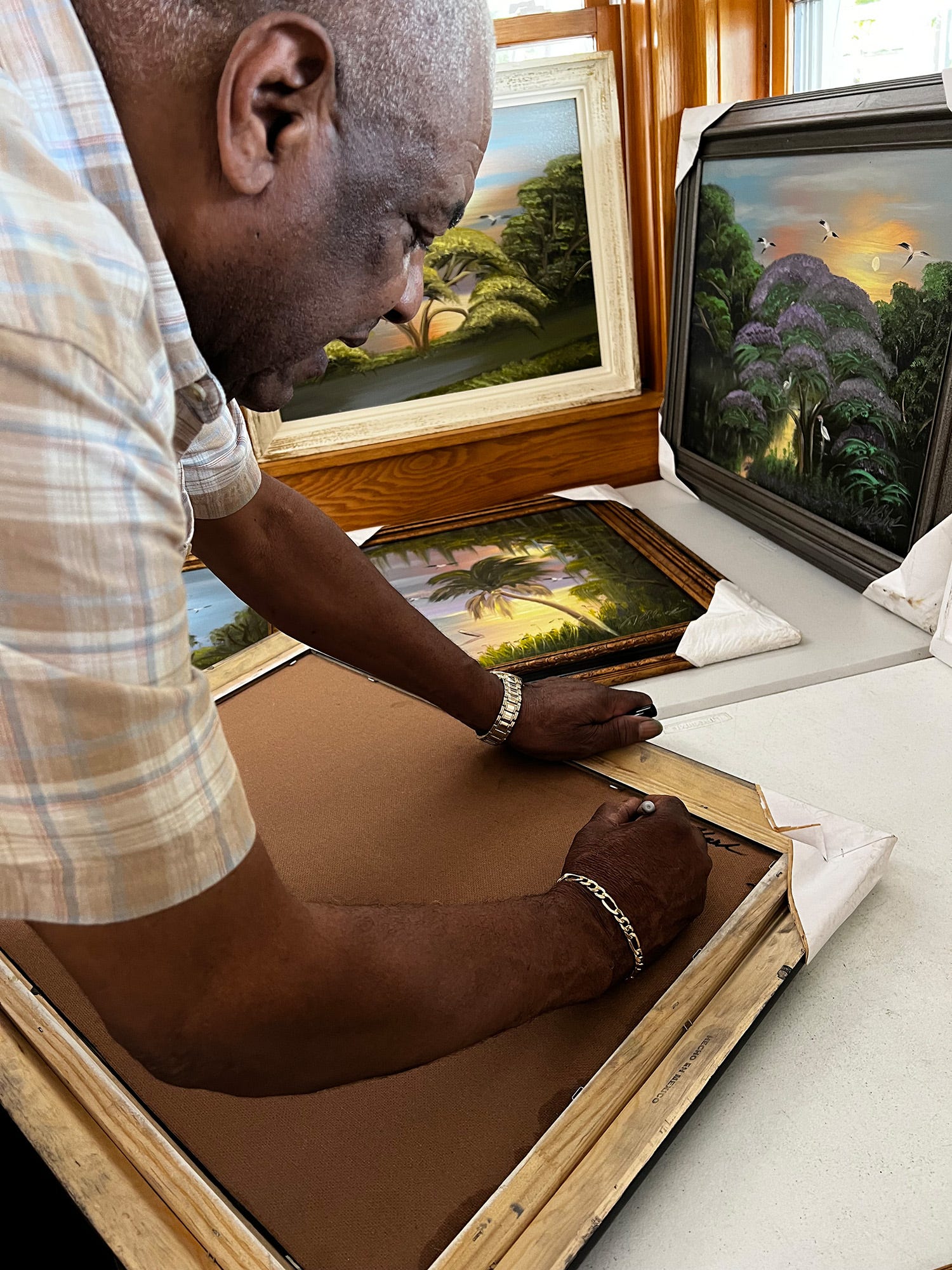
Al Black signing the reverse of a painting during our meeting. A personal photograph from my collection.
When I purchased the paintings, I appreciated them for their beauty and the opportunity to acquire work directly associated with one of the original Highwaymen. Over time, however, their meaning has grown.
I had them reframed and placed them in my bedroom, where they remain today. They are part of a room I see every day, and I have never grown tired of them.
One painting features a remarkable poinciana tree, its brilliant red canopy spreading across a quiet Florida landscape. The other depicts a more subdued setting, with palms, water, birds, and the familiar vegetation of the state’s subtropical environment.
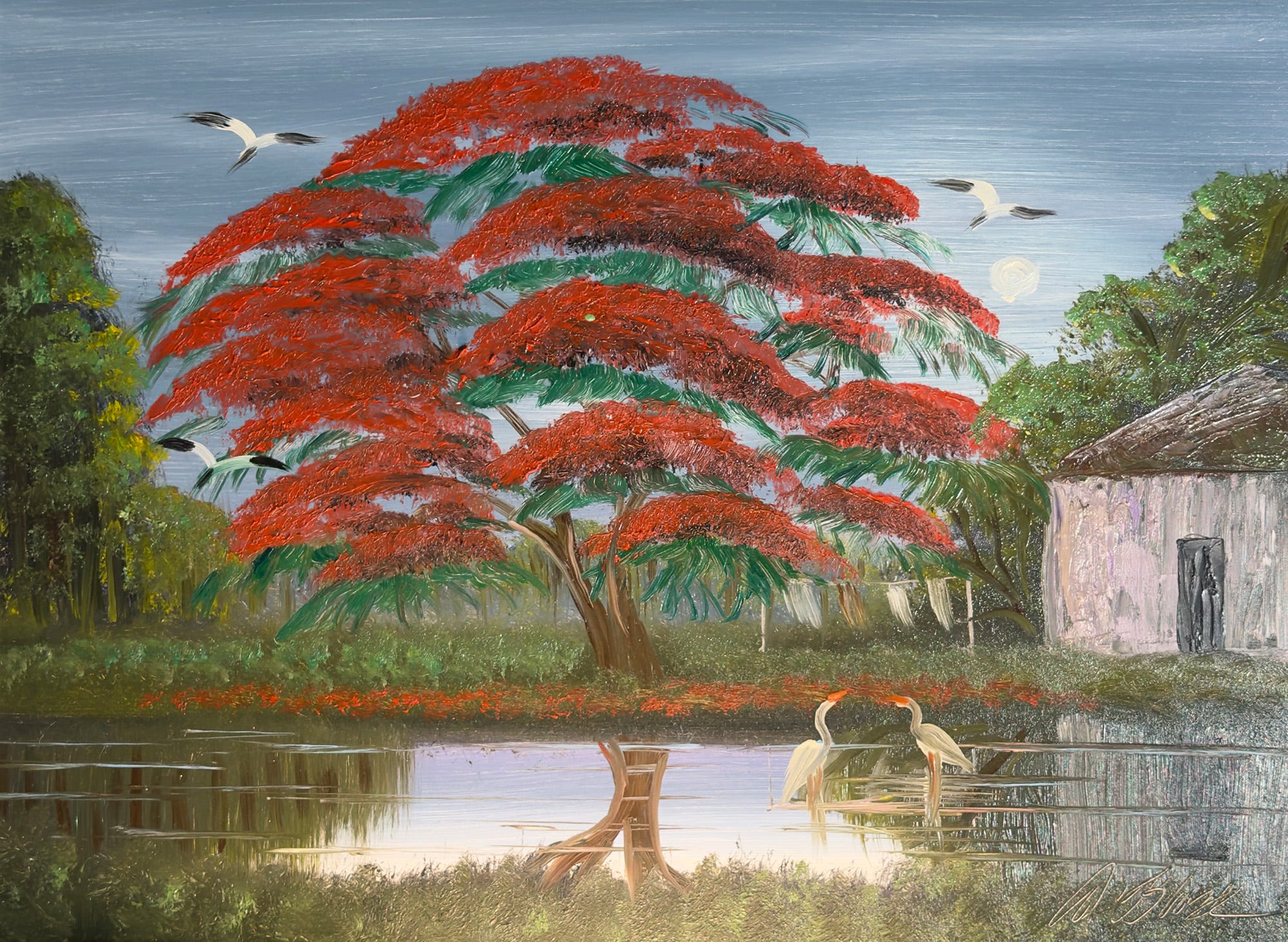
One of two paintings by Al Black in my personal collection, featuring the vivid color and tropical landscape imagery associated with the Florida Highwaymen. Photograph by Mark A. Middleton.
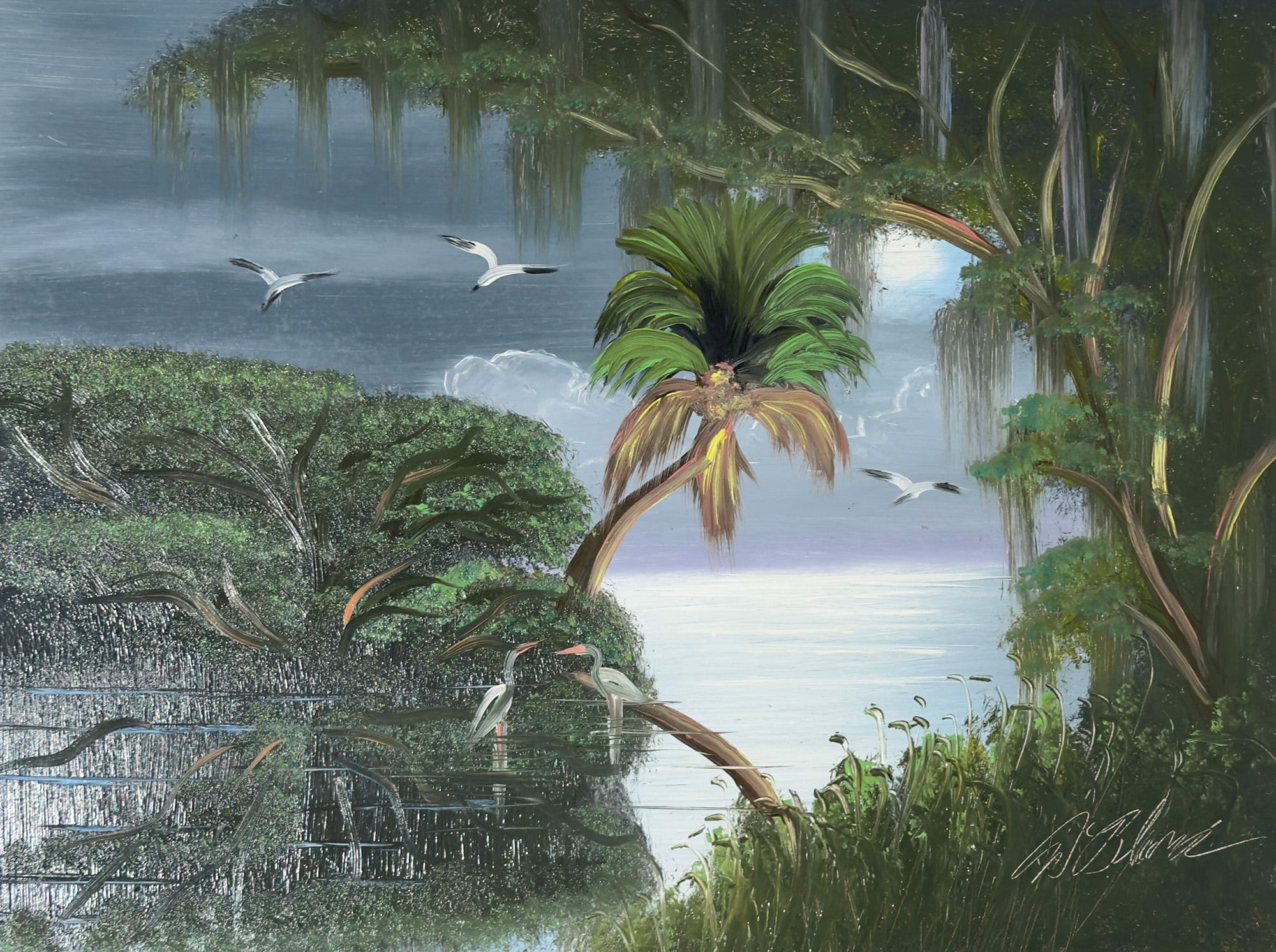
A second Al Black painting in my collection. Both works were reframed after I acquired them and remain displayed in my home. Photograph by Mark A. Middleton.
I occasionally think about the remarkable journey represented by these paintings. The movement began with artists who were excluded from many traditional galleries and who often had to sell their work wherever they could find a willing customer. Decades later, their paintings are recognized as important examples of American art, displayed in museums, studied by historians, and collected by people who appreciate their cultural significance.
For me, owning these paintings is not simply a matter of collecting art. It is a connection to a person I had the privilege of meeting and to a history I have come to admire.
Al Black died on May 12, 2025, at the age of 78. His passing marked the loss of another member of a generation whose artistic achievements were forged under circumstances very different from those faced by many artists today.
I am grateful that I had the opportunity to meet him while he was still here.
Mary Ann Carroll and the Women of the Highwaymen Story
Of the 26 original artists recognized as the Florida Highwaymen, Mary Ann Carroll was the only woman.
Her career deserves particular attention, both for the quality of her paintings and for the determination required to build an independent artistic life during the era in which she worked.
Born in Georgia in 1940, Carroll moved to Fort Pierce as a child. She developed an interest in painting after observing Harold Newton at work, particularly his depiction of a poinciana tree. Encouraged by Newton, she began experimenting with the medium and developed a style recognized for its vivid colors and striking interpretations of the Florida landscape.
Carroll traveled throughout the state selling her paintings, often balancing her artistic career with the responsibilities of raising seven children. Her life was demanding, and she worked at various jobs while continuing to paint.
Like the other Highwaymen, she developed a career outside the conventional gallery system. Unlike most of her colleagues, however, she also faced the challenges of establishing herself as a woman within a predominantly male group.
Her work became especially recognizable for its strong color and expressive treatment of tropical subjects.
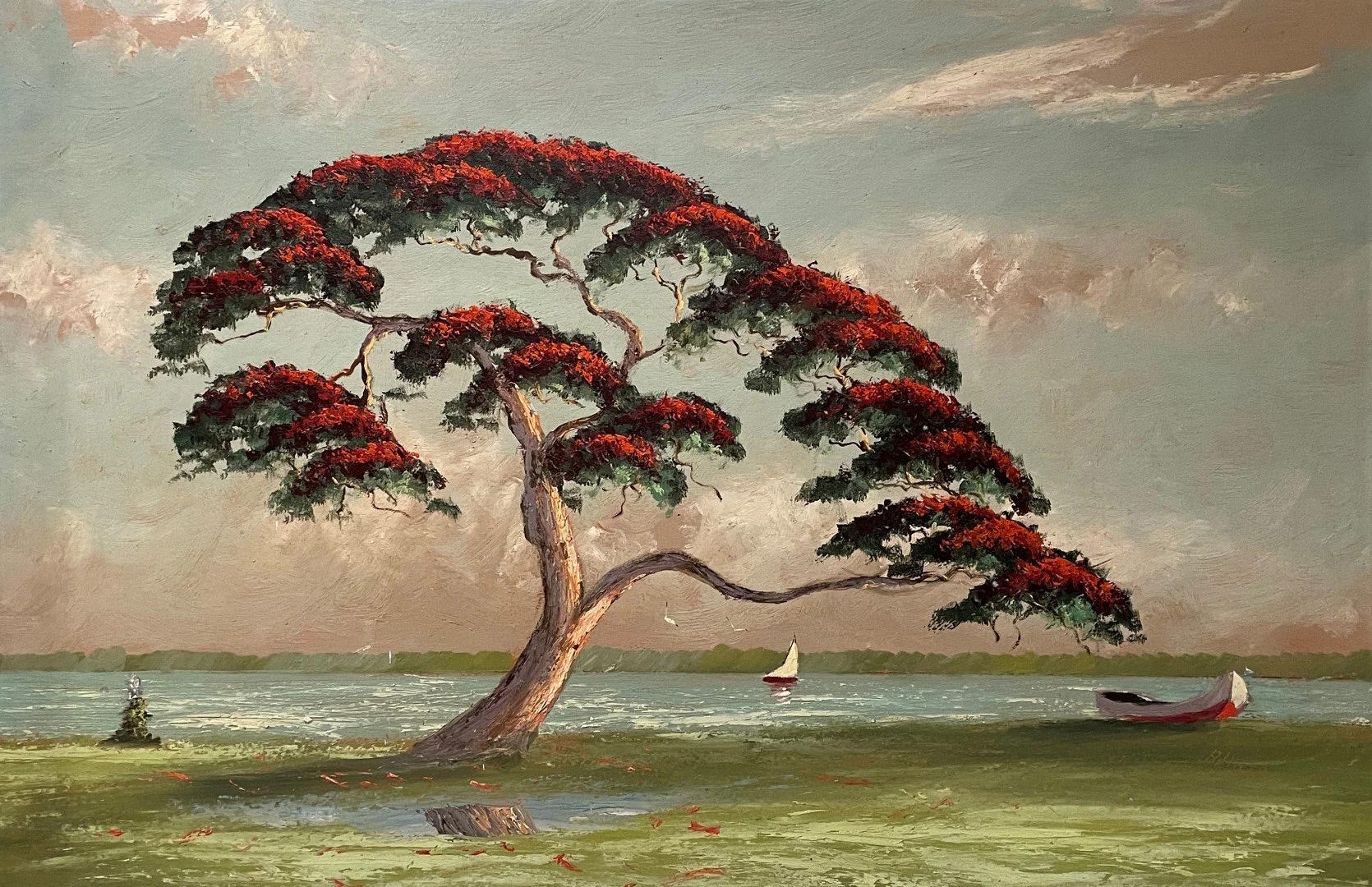
Mary Ann Carroll was the only woman among the original 26 Florida Highwaymen. Her colorful landscapes became an important part of the movement’s artistic legacy.
I remember that Mary Ann Carroll had an exhibition years ago at the Beach House Gallery in Dunedin, a gallery that has since closed. I have always appreciated opportunities like that, when the work of artists associated with an important chapter of Florida history becomes accessible within our own Tampa Bay communities.
One of the pleasures of living in this region is discovering how frequently its local cultural life connects with the larger history of the state. An exhibition in a small gallery can introduce people to an artist whose influence extends far beyond that particular setting.
Carroll’s recognition eventually reached the highest levels of public life. In 2011, she presented a painting to First Lady Michelle Obama at a luncheon in Washington, D.C. In February 2019, Florida First Lady Casey DeSantis selected Carroll as a featured artist for Black History Month, with her work displayed at the Florida Governor’s Mansion in Tallahassee.
It is difficult to imagine a clearer illustration of the transformation in how Highwaymen art came to be regarded.
Works that once had to be sold from automobiles because Black artists were excluded from many commercial galleries eventually found their way into one of Florida’s most prominent public residences.
Carroll died in 2019, leaving behind a body of work that remains significant both artistically and historically.
Her career should be remembered not merely as the exception of being the only woman among the original Highwaymen, but as the achievement of a talented and resourceful artist who pursued her work under challenging circumstances.
From Roadside Sales to Museums and the Governor’s Mansion
For much of the twentieth century, the Highwaymen’s paintings occupied an unusual position in Florida’s cultural life.
They were widely distributed, and thousands of residents and businesses owned their work, but the artists themselves received relatively little recognition from major institutions.
That began changing during the 1990s, as collectors and historians developed a renewed interest in regional Florida painting and the work of artists who had operated outside established galleries.
Art collector Jim Fitch played an important role in that rediscovery. His writing helped establish the name Florida Highwaymen and brought attention to the artistic and historical importance of the group.
Other collectors, researchers, museum professionals, and journalists followed, gradually creating a broader appreciation for the movement.
In 2004, the original 26 Highwaymen were inducted into the Florida Artists Hall of Fame, formal recognition of an achievement that had begun nearly half a century earlier.
Today, their paintings can be found in public and private collections throughout the country.
The Smithsonian’s National Museum of African American History and Culture in Washington, D.C., holds Highwaymen works as part of its collection. The Museum of Florida History in Tallahassee has also assembled an important collection, supported by acquisitions and donations through its museum foundation.
The A.E. Backus Museum and Gallery in Fort Pierce has long been an important institution for understanding regional landscape painting and the artistic environment from which the Highwaymen emerged.
The City of Fort Pierce has also established a museum dedicated to the Highwaymen at 1234 Avenue D, within the historic Lincoln Park community. Its exhibitions help preserve the work and history of the artists in the place where the movement first developed.
The museum’s significance extends beyond the paintings themselves. It provides an opportunity to explore the social circumstances, working methods, personalities, and commercial ingenuity that shaped the movement.
For those interested in the history of the Highwaymen, Fort Pierce is an especially meaningful destination.
The community remains closely associated with the artists, and its cultural institutions have helped establish a permanent place for their legacy.
The changing reputation of Highwaymen art is also reflected in the market for original paintings. Works that once sold for relatively modest amounts can now command thousands of dollars, and exceptional examples by important artists may achieve substantially higher prices.
These increases reflect growing demand, but they also raise questions about attribution, authenticity, condition, and historical importance. As with other established collecting fields, differences in artist, period, composition, medium, and provenance can have a considerable effect on value.
For collectors, the appeal extends beyond the possibility of financial appreciation.
These paintings are connected to an artistic movement whose members created opportunities for themselves despite formidable barriers.
That history remains an essential part of their significance.
A Legacy Continued by Another Generation
One of the most encouraging aspects of the Highwaymen story is that the artistic tradition did not end with the original painters.
Children, relatives, students, and other artists influenced by the movement have continued producing Florida landscapes in styles that reflect the techniques and subjects of the original Highwaymen.
Some learned by watching their parents paint. Others grew up helping prepare boards, assemble frames, transport artwork, or accompany family members on sales trips.
For them, the Highwaymen were not simply an art movement discussed in museums. They were parents, grandparents, relatives, and neighbors whose working lives unfolded in homes, workshops, and along Florida’s highways.
The McLendon family provides an especially meaningful example.
Roy McLendon Sr., one of the original Highwaymen, became known for his distinctive paintings of Florida landscapes and continued working for decades. His sons Roy McLendon Jr. and Ray McLendon developed artistic careers of their own, drawing on the traditions they encountered while growing up around their father’s paintings.
Ray has described helping prepare frames and accompanying his father on sales trips before eventually pursuing painting himself.
Other second-generation artists include Kelvin Hair, son of Alfred Hair, and members of families associated with Harold Newton and Robert Lewis.
The work of these artists raises an interesting question about the meaning of artistic legacy.
The historical designation “Florida Highwaymen” refers specifically to the original 26 artists inducted into the Florida Artists Hall of Fame. Their descendants and artistic successors are not automatically members of that original group, even when their work reflects its influence.
Nevertheless, the continuation of the tradition is important.
It demonstrates that the Highwaymen’s legacy is not confined to paintings produced during the 1950s, 1960s, and 1970s.
Their influence continues through techniques, subjects, family relationships, and the creative ambitions of younger artists who have inherited both the artistic tradition and the historical responsibility of preserving its story.
The future of Highwaymen art will depend not only on museums and collectors but also on the people who continue studying, interpreting, and creating within that tradition.
The Last Original Highwaymen and the Importance of Preservation
Time has brought an inevitable change to the original group.
Alfred Hair died in 1970, Harold Newton in 1994, Mary Ann Carroll in 2019, Roy McLendon Sr. in 2024, and Al Black in 2025. Many other members have also passed away.
By 2026, only a small number of the original artists remained living. The latest reporting available as this article was prepared identified Curtis Arnett and Sam Newton as the surviving members of the original group.
The movement has therefore entered a new chapter.
The people who created its paintings are increasingly represented through their work, historical accounts, photographs, interviews, and the memories of those who knew them.
This makes careful documentation especially important.
An artist’s signature may help identify a painting, but provenance, materials, stylistic characteristics, and the history of ownership can also contribute to our understanding of a work. For paintings whose creators are no longer living, reliable records become particularly valuable.
I appreciate this aspect of collecting in a more personal way because I had the opportunity to meet Al Black.
The photographs of our meeting, his signature on the back of a painting, and my recollection of purchasing the works all contribute to the history of the paintings I own.
They are not substitutes for a professional authentication when one is necessary, but they are meaningful records of my connection to the artist.
I am reminded of how easily those kinds of details can disappear over time.
A painting may pass from one owner to another, a gallery may close, or a family may lose the story behind an acquisition. Eventually, even a work by an important artist can become separated from the circumstances in which it was created or purchased.
Preserving those histories helps preserve the cultural meaning of the work itself.
What the Highwaymen Still Teach Us
I have traveled extensively and have been fortunate to visit museums, galleries, historic communities, and cultural institutions in many parts of the world. I have always been interested in how art reflects the circumstances of the people who create it.
The Florida Highwaymen offer an especially compelling example because their work tells two histories simultaneously.
The first is the environmental history of Florida.
Their paintings depict waterways, coastal vegetation, skies, wetlands, and landscapes that shaped the state’s identity long before much of its modern development. Even when the scenes are imagined or idealized, they preserve the visual vocabulary of a Florida that is familiar to anyone who has spent time exploring its natural environment.
The second is the social history of Florida during the era of segregation.
The artists’ careers developed in response to a society that restricted their opportunities. Rather than abandon their ambitions, they created an alternative marketplace, developed practical methods of production, and reached buyers directly.
Their independence should not obscure the injustice that made such independence necessary, but it deserves admiration.
Their paintings are now recognized for their artistic merit, historical importance, and distinctive contribution to American visual culture.
I find that recognition gratifying, although it came too late for many of the artists to experience its full benefits.
It also reminds me that artistic achievement is not always recognized by the institutions of its own time.
Sometimes the historical importance of a movement becomes apparent only when later generations begin asking different questions about whose work was valued, whose talent was overlooked, and how cultural traditions were shaped.
The Highwaymen challenge us to consider those questions carefully.
They also offer something less complicated but equally valuable: beautiful paintings.
I would never want their history to overshadow the pleasure of simply appreciating their art.
There is something wonderful about the color of a poinciana in bloom, the reflection of a palm against still water, or the atmosphere created by a dramatic Florida sky. Those images can be enjoyed without knowing anything about the lives of the artists who painted them.
Yet when we do know the history, the paintings become more meaningful.
Two Paintings on My Bedroom Wall
As I finish writing this article, I keep returning to the two Al Black paintings hanging in my bedroom.
I have had them for years, and they continue to bring me pleasure. I appreciate the colors, the familiar landscapes, and the unmistakable character of the work. I also appreciate knowing that I met the artist who created them and that I have photographs documenting that connection.
When I had the paintings reframed, my intention was simply to present them beautifully in my home. I did not anticipate that they would eventually become such meaningful reminders of a remarkable person and an important chapter of Florida history.
Today, their significance extends well beyond decoration.
They remind me of the individuals who created an artistic movement without the advantages of a conventional gallery system, of the Florida landscapes they chose to portray, and of the recognition their work eventually received.
They also remind me of Al Black himself.
I am grateful to have met him, grateful to own two of his paintings, and grateful that his work continues to be appreciated by collectors and institutions that understand its importance.
The original Highwaymen are passing from living memory into history. Their paintings, however, remain.
And as long as those paintings continue to be preserved, studied, exhibited, and enjoyed, the remarkable story of the Florida Highwaymen will remain part of the cultural history of our state.
About the Author
Mark A. Middleton is a Tampa Bay Realtor with Middleton Tampa Bay | Compass, a historian with a degree from the University of South Florida, and a documentary photographer and filmmaker. His writing explores Florida history, architecture, art, photography, historic homes, and the people whose stories have helped shape the places we know today.
Through The Journal at Middleton Tampa Bay, Historic Homes Tampa Bay, Middleton Tampa Bay, and his photography website, he shares his interests in history, travel, preservation, and visual storytelling.
Sources and Further Reading
Florida Department of State: Alfred Hair and the Florida Highwaymen
Smithsonian National Museum of African American History and Culture: Florida Highwaymen
Woodson African American Museum of Florida: The Highwaymen’s Next Generation
I welcome the memories and experiences of readers who have collected Florida Highwaymen paintings, met the original artists, or attended their exhibitions. Their history belongs to Florida, and the stories preserved by collectors and families can help future generations better understand this extraordinary artistic movement.