

When I first began spending time in Dunedin, I wasn’t particularly concerned with its history. I was drawn instead by the pleasures of the place: running along the Pinellas Trail, enjoying the restaurants downtown, and exploring streets that seemed designed for walking rather than driving. I found myself returning almost every weekend, often staying long after my run was finished. Eventually, it occurred to me that the community I enjoyed visiting so much was somewhere I wanted to live. In 2013, I made Dunedin my home.
What I couldn’t have anticipated was how much my appreciation for the city would deepen over the years. Through my work in real estate, my involvement with the Rotary Club of Dunedin North, and the research and interviews that went into producing my documentary, Delightful Dunedin, I began discovering the history behind places I had passed countless times. More importantly, I developed friendships with people whose families and contributions are woven into that history.
As someone who earned a degree in history from the University of South Florida, I’ve always been interested in the relationship between the past and the present. History provides context for the world around us, offering explanations for everything from the arrangement of our streets to the traditions we celebrate. Dunedin is an especially rewarding place to study because so much of its past remains visible in its architecture, waterfront, neighborhoods, and daily life.
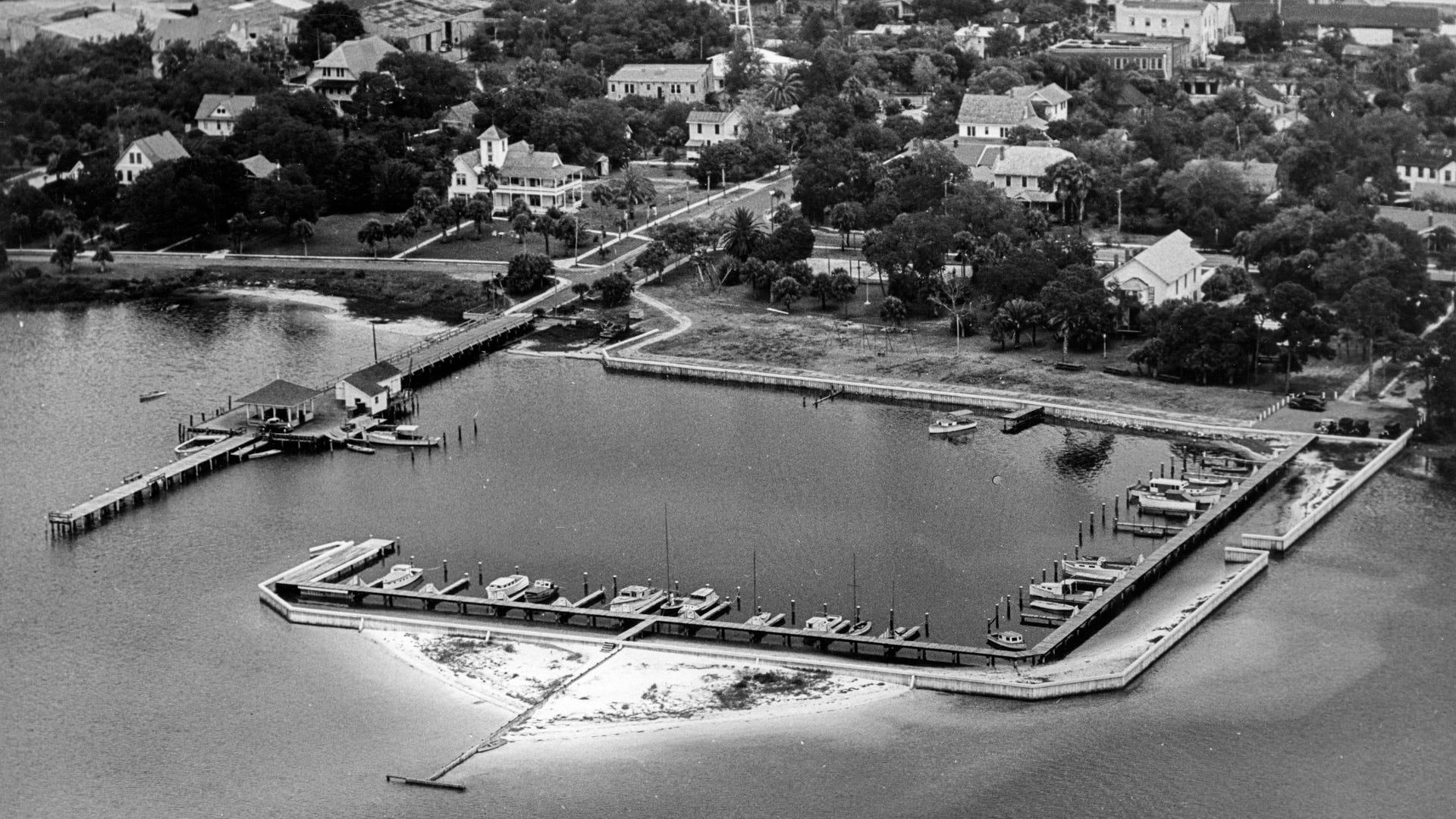
An archival view of Dunedin’s waterfront and marina, illustrating the close relationship between the early residential community and St. Joseph Sound.
I particularly enjoy looking at old photographs of Dunedin’s waterfront. In one, the marina is surrounded by modest homes, mature trees, and narrow streets leading toward the shore. The buildings and boats belong to another era, yet the essential character of the place is recognizable. The relationship between the town and the water, established long before Dunedin became a destination for visitors, remains central to its identity.
To understand how this small coastal community developed, we have to look beyond its familiar Scottish celebrations and picturesque downtown. Dunedin’s history includes Indigenous settlement, maritime commerce, agriculture, transportation, architectural development, and the efforts of generations of residents who helped shape the community.
A Coastal Settlement Takes Shape
Long before European settlers arrived in what is now Dunedin, Indigenous peoples inhabited and used the shores and islands surrounding Tampa Bay and the Gulf Coast. The region’s archaeological history reflects communities whose lives were closely tied to the coastal environment, including groups commonly identified in historical accounts as the Tocobaga. Fishing, shellfish gathering, and access to the surrounding waterways were essential to life along this stretch of Florida.
European exploration and colonization transformed the region over the following centuries. Disease, displacement, conflict, and changing political authority disrupted Indigenous communities, while new settlements gradually appeared along Florida’s Gulf Coast. By the nineteenth century, agricultural and maritime activity had begun establishing the foundations of the communities we recognize today.
The first recorded land deed in the area that would become Dunedin dates to 1852, when Richard L. Garrison acquired property. Florida had entered the Union only seven years earlier, and the peninsula remained sparsely settled in comparison with the cities and towns that would emerge during the following century.
Early settlers encountered a landscape dominated by coastal vegetation, wetlands, pine forests, and hammocks. Overland transportation was difficult, and the waterways provided practical connections to neighboring settlements and markets. Schooners and sloops carried goods, supplies, and passengers along the coast, making the development of docks and wharves essential to the local economy.
Dunedin eventually became an important trading center, with a sailing fleet described in historical accounts as the largest in Florida at one time. For a community now best known for its restaurants, waterfront parks, and sunsets, this maritime past is worth remembering. The harbor was originally a commercial asset, connecting a relatively isolated settlement to the wider economy of the Gulf Coast.
During the nineteenth century, the settlement was known as Jonesboro, a name associated with George L. Jones, who operated a general store in the area. In 1882, two Scottish merchants, John O. Douglas and James Somerville, petitioned to establish a post office under a different name. They chose Dunedin, derived from Dùn Èideann, the Scottish Gaelic name for Edinburgh.
The name would become one of the city’s most enduring connections to its origins.
The community grew gradually during the final decades of the nineteenth century. Agriculture supported many of its residents, with cotton and citrus becoming particularly important. Much of the land that now forms the commercial heart of downtown was once agricultural property, a remarkable contrast to the restaurants, shops, and public spaces that occupy the area today.
The arrival of the Orange Belt Railway in 1888 was a turning point. While maritime transportation remained important, the railroad offered new opportunities for moving passengers, agricultural products, merchandise, and building supplies. Businesses developed around the railway corridor, helping establish the street patterns and commercial center that would shape modern downtown Dunedin.
On June 1, 1899, Dunedin officially incorporated as a town. Its population was still small, numbering approximately one hundred residents near the end of the nineteenth century, but the essential elements of an organized community were taking shape.
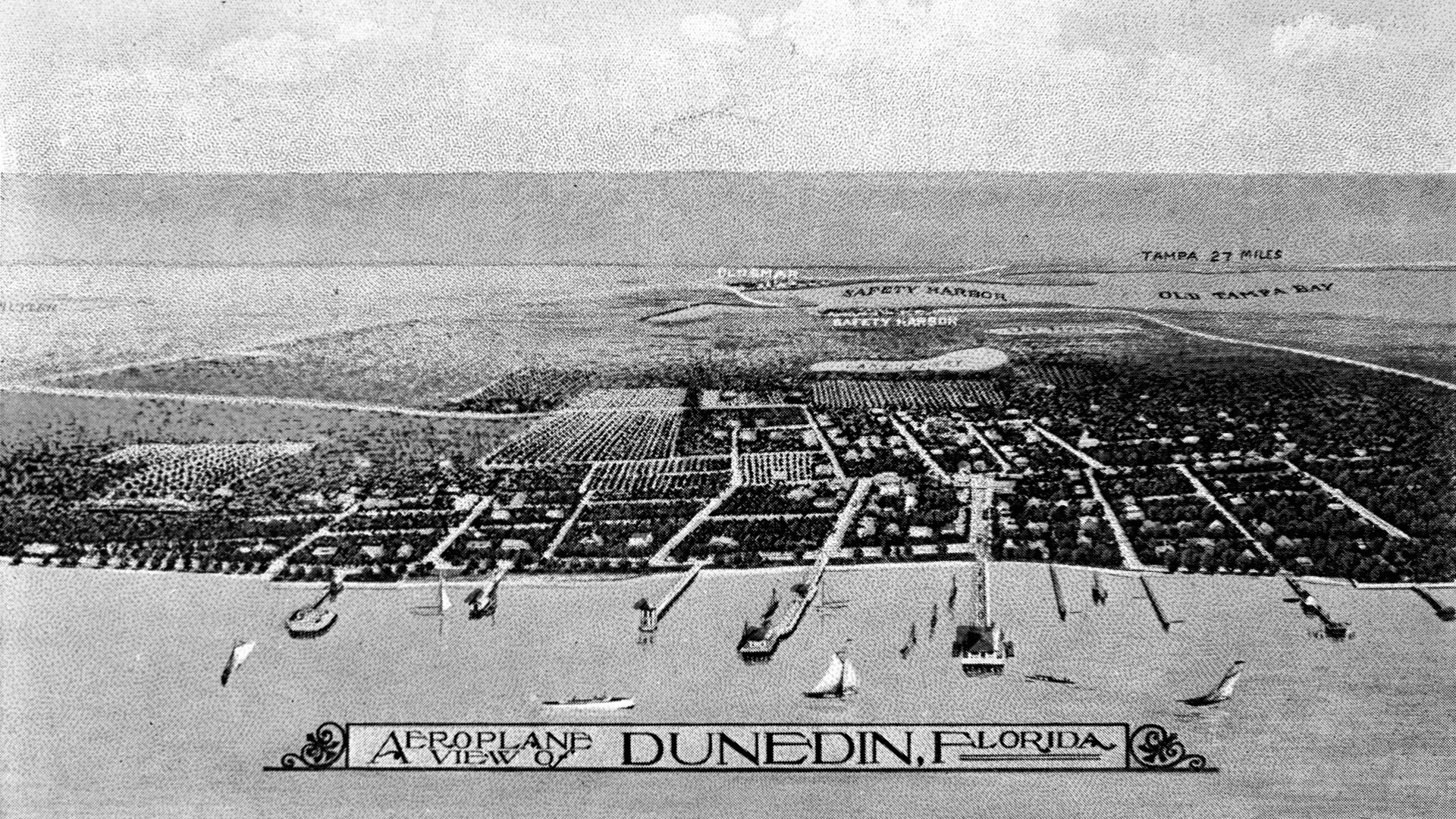
An early illustrated view of Dunedin showing the town’s planned streets, waterfront, and surrounding landscape.
These early images are fascinating because they reveal a community whose geography remains familiar even as its buildings, industries, and population have changed. The original relationship between downtown, the surrounding neighborhoods, and St. Joseph Sound continues to influence the way people experience Dunedin.
The Scottish Heritage That Became Part of Everyday Life
Dunedin’s Scottish identity is among its most recognizable characteristics, although the traditions we associate with the city today developed over many decades. Street names such as Scotland Street, Highland Avenue, and Louden Avenue reflect those origins, while pipe bands, Highland dancing, and cultural celebrations have become important expressions of community identity.
In 1964, Dunedin established a sister-city relationship with Stirling, Scotland, strengthening its connection to the country that inspired its name. The city’s Scottish musical traditions grew through its schools and community organizations, supported by residents who believed those traditions were worth preserving.
The Dunedin Highland Games emerged from those efforts in 1967, when a committee of volunteers and supporters organized to raise funds for the city’s pipe bands and Scottish musical programs. Over time, the Games became one of the community’s most recognizable annual events, bringing together traditional music, dancing, athletics, and cultural celebrations.
One of my favorite experiences while making Delightful Dunedin was spending time talking with my friend Dr. Pat Snair. Her father, Sid Snair, was one of the people who helped establish the Highland Games, and her family’s involvement provides a direct connection to an important chapter in the city’s cultural history.
I have always enjoyed researching the lives of people who shaped the communities in which we live. As a historian, however, I know there is a difference between reading about someone in an archival document and having a conversation with a person whose family participated in the events being studied. Speaking with Pat brought that distinction into focus. The Highland Games were no longer simply an annual celebration with an interesting origin. They became a story about particular people, their commitment to Scottish culture, and the tradition they hoped to pass along to future generations.
Pat has continued that family legacy through her involvement in Dunedin’s Scottish arts community. Her work, along with the contributions of many other volunteers, demonstrates how traditions survive through sustained personal involvement rather than historical recognition alone.
For me, those conversations were among the most rewarding parts of making the documentary. To be connected so closely to people whose families helped establish Dunedin’s traditions is a privilege, particularly when those relationships develop into genuine friendships.
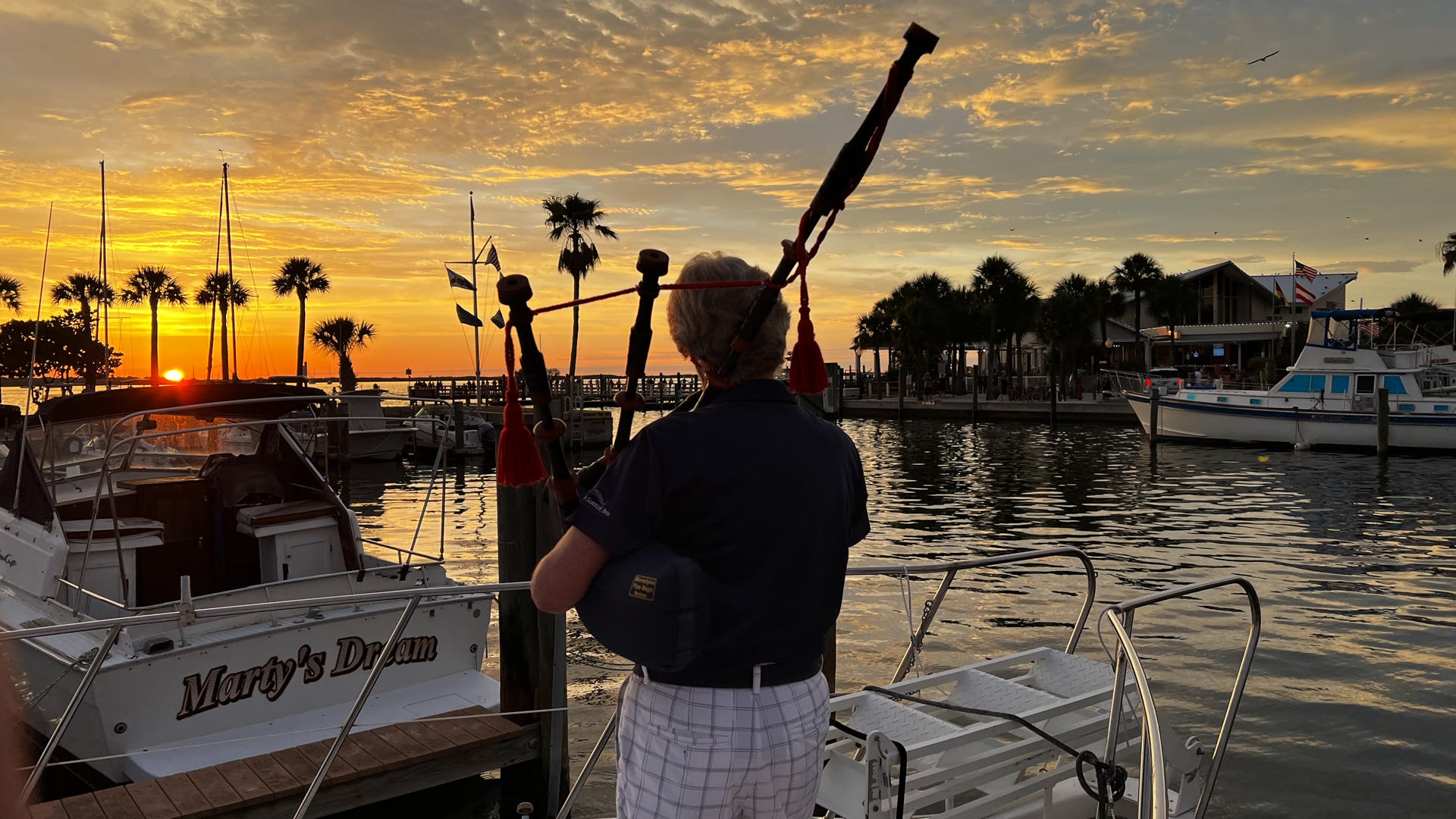
Scottish heritage remains a living part of Dunedin’s culture. Photograph by Mark Middleton.
I love this photograph of a bagpiper standing near the marina as the sun sets over St. Joseph Sound. It brings together several elements of Dunedin’s identity: the Scottish traditions established by its early residents, the maritime history of the waterfront, and the coastal landscape that has attracted people here for generations.
There is something particularly meaningful about seeing traditions survive in the very place where they developed. The sound of bagpipes along the waterfront belongs to modern Dunedin, but its significance is rooted in a much longer story.
Railroads, Citrus Groves, and the Making of Modern Dunedin
The railroad’s arrival in 1888 helped Dunedin participate more fully in Florida’s developing economy. Agricultural products could be transported to distant markets, and visitors gained easier access to communities that had previously depended heavily on coastal shipping. The commercial district developed around the tracks, with businesses serving residents, travelers, and the surrounding agricultural economy.
Citrus was particularly important. Orange groves occupied substantial portions of the surrounding landscape, although the industry faced serious challenges. The devastating freezes of 1894 and 1895 destroyed or damaged groves throughout Florida, creating hardships for growers and communities dependent upon agricultural income.
The industry nevertheless continued to develop. Dunedin became associated with citrus production and processing, including the work of the Skinner family, whose business interests contributed to innovations in the handling and processing of citrus products. These developments formed part of a much larger transformation of Florida’s agricultural economy during the twentieth century.
The city’s residential architecture reflects this history of changing prosperity. Homes constructed during the late nineteenth and early twentieth centuries were often relatively modest, designed for the needs of local families and the realities of Florida’s climate. Wide porches, elevated foundations, generous windows, and shaded outdoor spaces helped make life more comfortable before modern air-conditioning.
As Florida entered its great land boom during the 1920s, the scale and architectural ambition of development changed. Dunedin became a city in 1925, and new residential neighborhoods emerged as developers sought to capitalize on the state’s growing appeal.
Craftsman bungalows, Florida vernacular cottages, Colonial Revival residences, and Mediterranean-influenced buildings became part of the city’s architectural landscape. Some of these homes remain today, particularly in the older neighborhoods surrounding downtown and the waterfront.
My work as a Realtor has given me opportunities to explore historic homes throughout Tampa Bay, and Dunedin’s older residential areas hold particular interest for me. The craftsmanship, proportions, and architectural details found in these properties offer clues about the people who built them and the circumstances of their time.
An original front porch might reveal how residents sought relief from the summer heat. A home’s roofline, windows, and decorative details may reflect architectural fashions popular during a particular decade. Its location may also reveal something about the community’s early transportation routes, commercial activities, or access to the waterfront.
The history of a home does not determine its market value, and older properties can present significant practical considerations involving maintenance, renovation, and insurance. Nevertheless, historical context can help us understand why certain properties and neighborhoods possess a character that newer development cannot easily reproduce.
This relationship between architecture and community history is central to my work at Historic Homes Tampa Bay, where I explore the buildings, neighborhoods, and architectural traditions that distinguish our region.
One of Dunedin’s most prominent buildings from the land-boom period is the Fenway Hotel on Edgewater Drive. Construction began in 1924, and the hotel celebrated its grand opening on January 8, 1928. Its Mediterranean-influenced architecture and waterfront setting reflected the ambitions of a community developing an identity as a winter destination.
The Fenway became associated with music, entertainment, and early radio broadcasting. After experiencing different uses and periods of decline, the building underwent an extensive restoration and reopened as a hotel in 2018.
Its preservation demonstrates how historic buildings can retain architectural significance while finding new purposes. The Fenway is no longer the same institution it was during the late 1920s, but its survival allows an important part of the city’s architectural and cultural history to remain accessible.
Another of Dunedin’s most successful examples of adaptation is the former railroad corridor that runs through the center of town. After railway operations ended, the abandoned route eventually became part of the Fred Marquis Pinellas Trail.
The trail is now one of Dunedin’s defining public amenities, connecting neighborhoods, parks, businesses, and surrounding communities. Its route through downtown is particularly significant because it follows a transportation corridor that helped establish the commercial center more than a century earlier.
This history has a special personal meaning for me. Long before I understood the role of the Orange Belt Railway in Dunedin’s development, I was spending my weekends running along the same corridor. Those runs eventually led me to discover the restaurants, streets, and atmosphere that convinced me to make Dunedin my home.
The railroad brought people and commerce into the community during the nineteenth century. Today, the trail brings residents and visitors into downtown for recreation, dining, shopping, and the pleasure of exploring the city on foot.
It is difficult to imagine a more appropriate continuation of the corridor’s original purpose.
The historic railroad depot, reconstructed in its present form in 1924, now houses the Dunedin History Museum. Once a place that welcomed travelers, the building has become an institution dedicated to preserving and interpreting the community’s past.
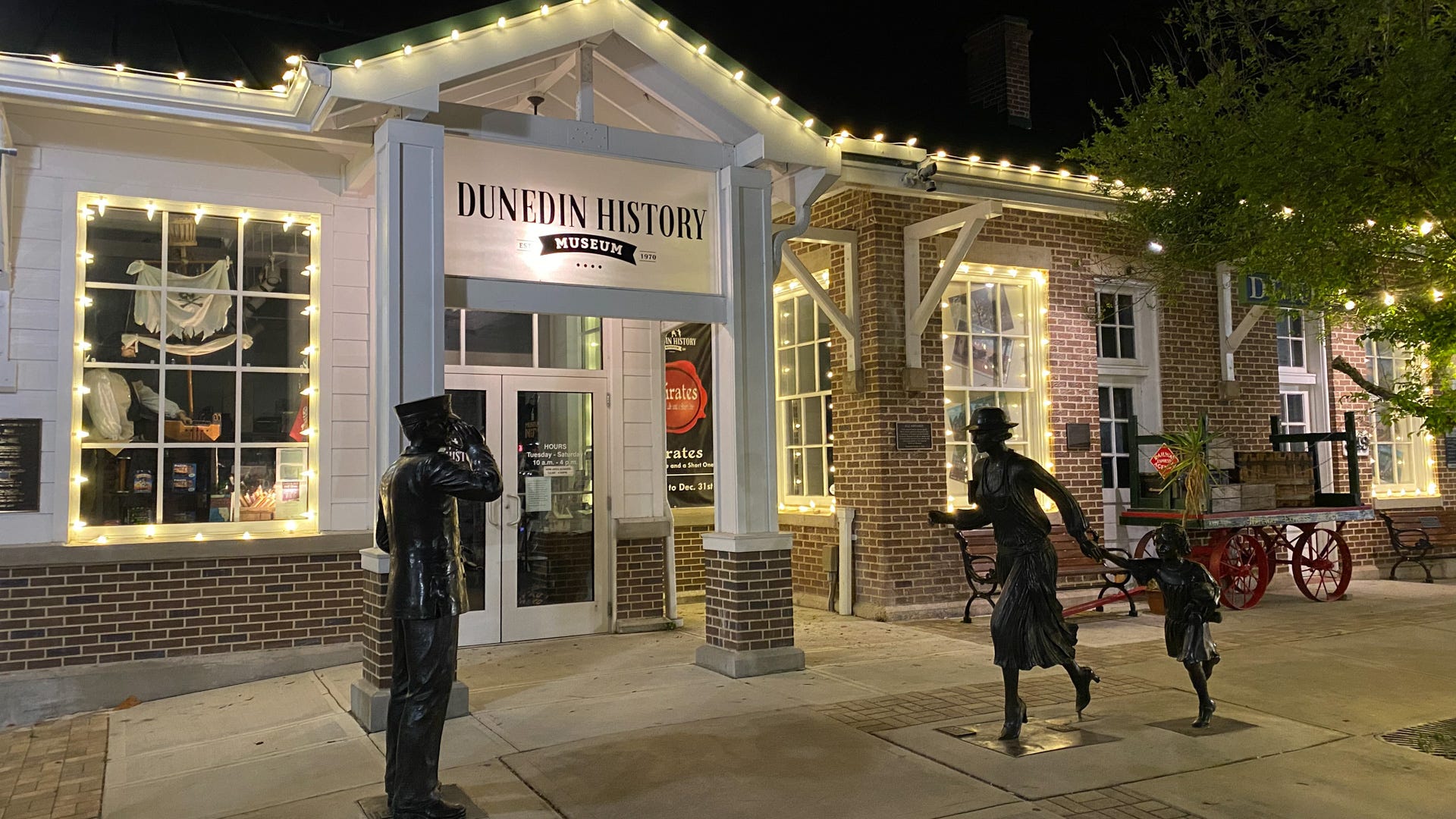
The Dunedin History Museum occupies the city’s historic railroad depot, preserving a direct connection to Dunedin’s transportation history. Photograph by Mark Middleton.
I have spent considerable time researching the railroad’s role in the development of Dunedin and the transformation of its corridor into the Pinellas Trail. The subject is explored more extensively in my article, The Pinellas Trail Through Dunedin: A Complete Guide.
An Island Coastline with a History of Its Own
Dunedin’s relationship with the water extends beyond its maritime origins and waterfront neighborhoods. The barrier islands to the west have their own histories, shaped by storms, changing shorelines, development, and conservation.
Before the hurricane of 1921, the land associated with present-day Honeymoon Island and Caladesi Island formed part of a larger barrier island known as Hog Island. The storm opened Hurricane Pass, separating the land and altering the geography of the coastline.
In the late 1930s, businessman Clinton Washburn promoted the northern island as a destination for newly married couples. Honeymoon cottages were constructed, and the first couples arrived in May 1940. Although the venture itself was relatively short-lived, the name Honeymoon Island endured.
Today, Honeymoon Island State Park and neighboring Caladesi Island are among the region’s best-known natural destinations. Their beaches, coastal vegetation, wildlife, and surrounding waterways attract visitors throughout the year, while also providing important habitat within an increasingly developed region.
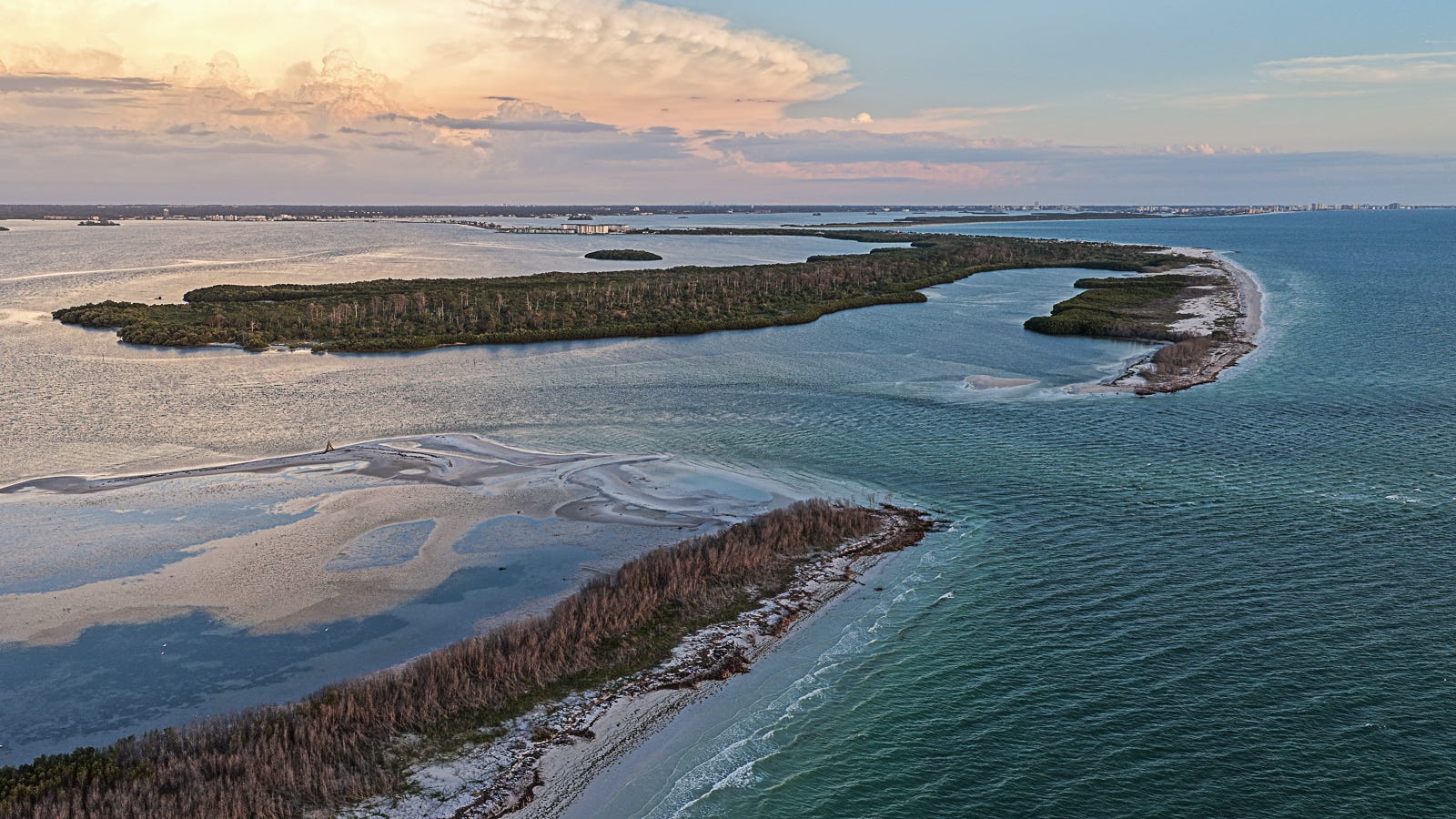
The barrier islands west of Dunedin, where storms, erosion, and shifting coastal processes continue to reshape the landscape. Aerial photograph by Mark Middleton.
I’ve spent many hours photographing this coastline, and the experience has given me a greater appreciation for the ways natural history intersects with human activity. Changes that might be difficult to recognize from one day to the next become much more apparent when photographs are compared over several years.
Recent storms have provided striking reminders that the islands are neither permanent nor fixed in their present form. Shorelines erode, channels change, and sand moves under the influence of wind, water, and coastal currents.
I explored some of those changes in greater detail in The Day Honeymoon Island Started Breaking Apart, and the New Island It Became, published through my Discover Delightful Dunedin website.
Hammock Park offers another perspective on the natural landscape. Its preserved habitats provide a quiet contrast to downtown’s commercial activity and the open views along the waterfront. I regularly walk and run through the park, and it remains one of my favorite places to enjoy a quieter side of the community.
Hammock Park preserves part of the natural environment that once characterized much of the Dunedin area. Photograph by Mark Middleton.
Places such as Hammock Park and Honeymoon Island remind us that the city’s character cannot be understood through buildings and streets alone. Natural landscapes have shaped its development from the beginning, influencing settlement patterns, transportation, recreation, and the way residents experience life along the Gulf Coast.
The People Who Continue to Shape Dunedin
Over the decades following World War II, Dunedin expanded along with the rest of Pinellas County. New subdivisions, businesses, public facilities, and recreational opportunities changed the city considerably.
Golf became part of its identity, including the historic Dunedin Golf Club and its connection to the PGA of America. In 1977, the Toronto Blue Jays began spring training in Dunedin, establishing another enduring relationship that introduced the community to baseball fans well beyond Florida.
Downtown changed as well. Buildings found new uses, restaurants and shops attracted visitors, and the former railroad corridor became a recreational asset. The city developed a reputation for its walkability, active waterfront, and distinctive local character.
Downtown Dunedin, where the historic street pattern, local businesses, and walkable atmosphere remain central to community life. Photograph by Mark Middleton.
These qualities were among the first things I appreciated about Dunedin, and they remain important to me today. Yet after living here for more than a decade, I find that my strongest attachment to the city has as much to do with the people I’ve come to know as it does with the setting.
My involvement with the Rotary Club of Dunedin North has been particularly meaningful. Through Rotary, I’ve had the opportunity to work alongside neighbors who devote their time and resources to making the community stronger. Our projects have involved practical service, support for local organizations, and the kind of steady volunteer work that often receives little public attention.
Some of my closest friends are members of the club. The relationships we’ve built through service have become an important part of my life, and they have also deepened my understanding of Dunedin.
When we discuss the history of a community, we naturally focus on the people who founded businesses, built homes, established institutions, or held public office. Their contributions deserve recognition, but the continued vitality of a town also depends on people whose names may never appear prominently in historical accounts.
Volunteers maintain public spaces, organize events, support local families, preserve cultural traditions, and contribute to the organizations that give a community its sense of connection. Much of that work happens quietly, through friendships and relationships developed over many years.
My experiences with Rotary have made those contributions more visible to me. They have also reinforced something I learned while creating Delightful Dunedin: the history of a place is inseparable from the people who live there.
The conversations I enjoyed with Dr. Pat Snair are a particularly good example. Her father’s involvement in establishing the Highland Games connects her family to an important chapter of Dunedin’s cultural history. The continuation of those traditions depends upon people who care enough to preserve them.
The same principle applies to historic preservation, environmental conservation, public service, and the many other activities that contribute to Dunedin’s identity.
The people who shaped this community in earlier generations established a foundation. The responsibility for what it becomes next belongs to those who live here today.
Photographing the Past and Present
Photography has always influenced the way I experience the places I visit. When traveling, I find myself paying attention to architectural details, the arrangement of streets, the interaction between people and public spaces, and the ways a landscape changes throughout the day.
I approach Dunedin with the same curiosity.
Sometimes a photograph captures a familiar historic building in unusual light. Other times it records an ordinary moment along the waterfront or a detail that reveals something about the community’s character.
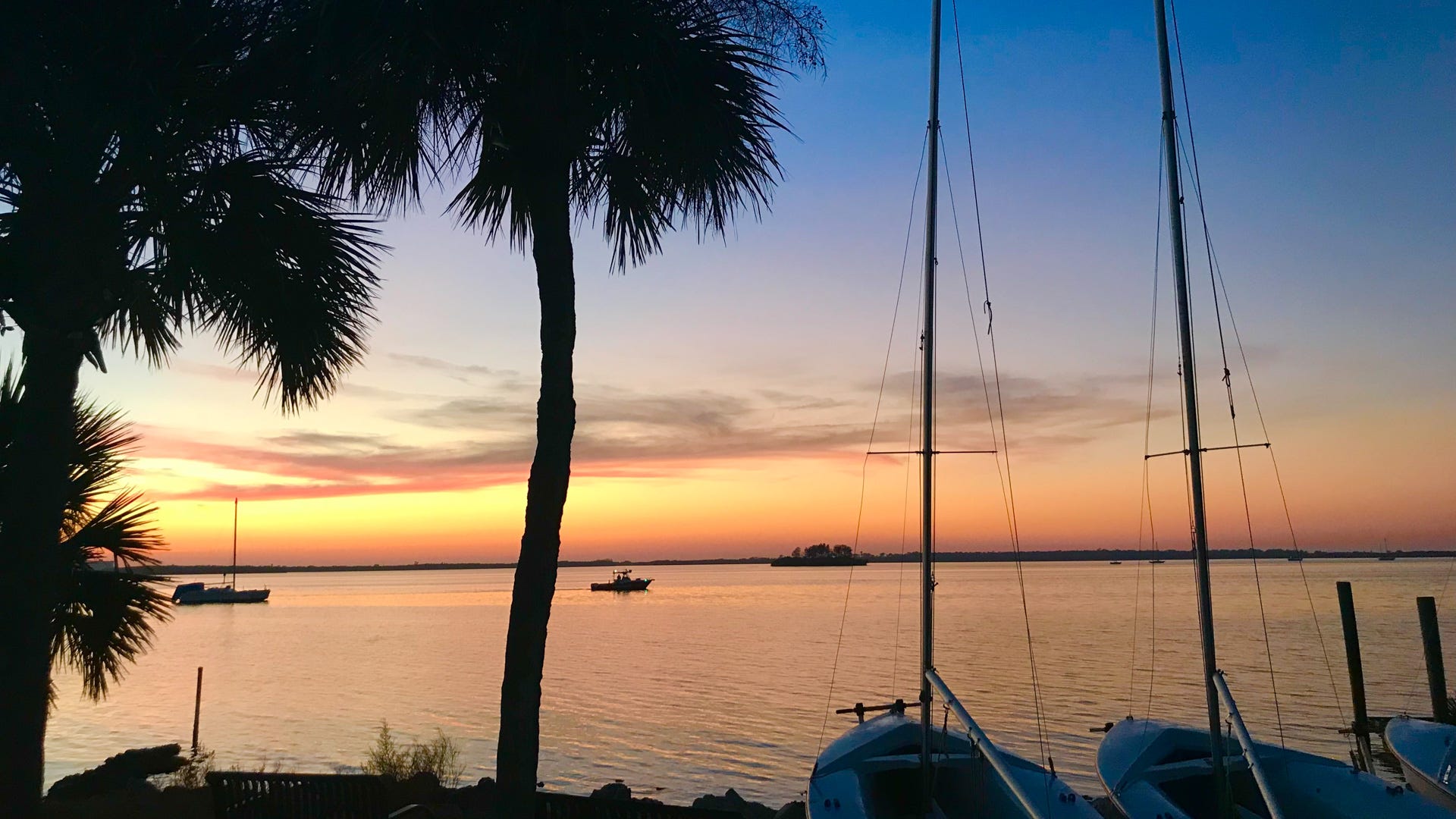
Evening at the Dunedin marina, overlooking St. Joseph Sound. Photograph by Mark Middleton.
I particularly enjoy photographing the marina in the evening, when the setting sun illuminates the water and the masts of sailboats become silhouettes against the sky. It is a scene that has become familiar to generations of residents, although the vessels and surrounding buildings have changed considerably.
Those contrasts between past and present helped inspire Delightful Dunedin, the documentary I created to explore the city’s history, people, and daily life.
The process took me beyond the places I already knew. Research led to conversations, conversations led to new discoveries, and familiar landmarks acquired stories that changed the way I understood them.
Producing the film was especially rewarding because it allowed me to bring together several interests that have been part of my life for years: history, photography, filmmaking, and a genuine curiosity about the places and people around me.
The film also introduced me to stories that deserved greater attention, including the experiences of residents whose contributions helped establish some of Dunedin’s most recognizable traditions.
Through Discover Delightful Dunedin, I continue sharing photographs, historical articles, and observations about the community. The website and documentary reflect my belief that local history should be accessible to everyone, not confined to archives or academic publications.
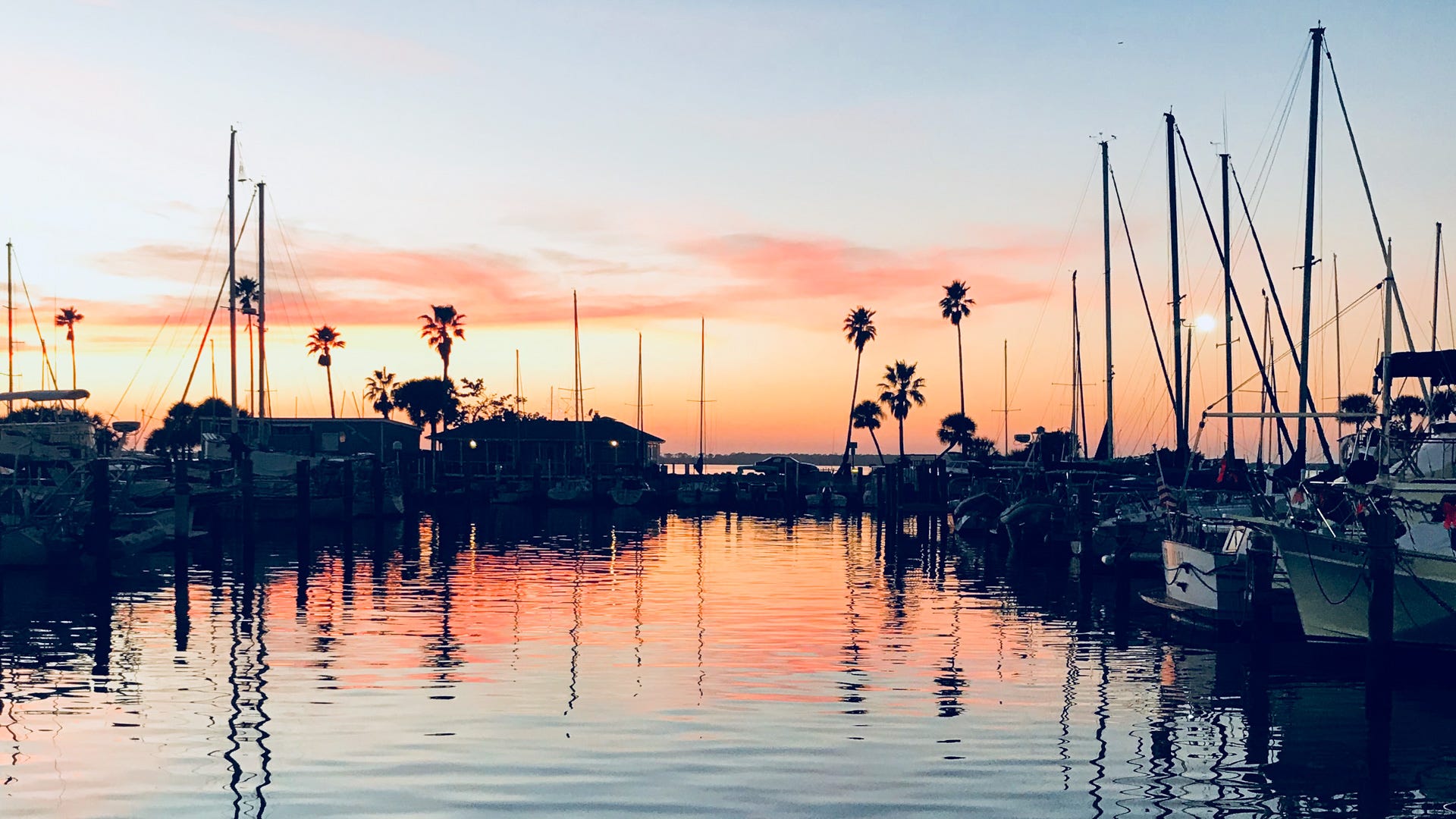
The changing evening light over Dunedin’s waterfront. Photograph by Mark Middleton.
Dunedin has given me countless opportunities to explore that relationship between place and memory. The more I learn about its history, the more interesting its ordinary details become.
A street name can preserve a connection to an early settler. A house may reveal the architectural tastes of another generation. A former railroad depot can explain the location of a downtown that continues to thrive. Even a quiet evening at the marina becomes part of a larger story when considered against the city’s maritime past.
What Dunedin’s History Means for Its Future
Dunedin today is considerably different from the small settlement that developed along St. Joseph Sound during the nineteenth century. Its population has grown, its economy has changed, and its physical landscape continues to evolve.
Yet several qualities that contributed to its development remain important: a close relationship with the waterfront, a recognizable downtown, established residential neighborhoods, cultural traditions, and public spaces that bring people together.
Preserving those qualities while accommodating growth presents continuing challenges. Communities must consider housing needs, development pressures, environmental concerns, transportation, historic preservation, and the expectations of residents whose experiences and priorities may differ.
History cannot resolve every disagreement about the future. It can, however, provide valuable perspective about the decisions that brought a community to its present condition.
As a Realtor working throughout Tampa Bay, I’ve seen how strongly neighborhood character influences people’s decisions about where they want to live. Buyers certainly consider property condition, pricing, amenities, and practical matters, but the appeal of a community often extends beyond anything that can be measured in a property description.
Walkability, established neighborhoods, access to recreation, architectural character, and opportunities for connection all contribute to the experience of living in a particular place.
Dunedin offers a compelling combination of those qualities, which helps explain why it remains attractive to people considering a move to Florida’s Gulf Coast.
For readers interested in the practical side of living here, I have developed a comprehensive guide to Dunedin’s homes, neighborhoods, and lifestyle through Middleton Tampa Bay | Compass. It explores the community from a residential real estate perspective, complementing the historical and cultural subjects discussed here.
I believe an appreciation for local history can make us more thoughtful about both real estate and community development. When we understand the age and origins of a neighborhood, the reasons its streets were arranged in a particular way, or the architectural characteristics that distinguish its homes, we gain a fuller understanding of what makes it worth preserving.
The same applies to the natural environment and civic institutions. These are all parts of a community’s identity, shaped through decisions made over many generations.
The Dunedin I Came to Know
I sometimes think about how differently my relationship with Dunedin began.
At the time, I was simply looking for somewhere enjoyable to run on the weekends. I liked the Pinellas Trail, appreciated the restaurants and walkable downtown, and found myself returning often enough that moving here eventually seemed like a natural decision.
I had no idea that I would later spend so much time studying the history of the city, photographing its neighborhoods, or producing a documentary about the people and places that make it distinctive.
I certainly could not have anticipated the friendships that would develop along the way.
Today, when I think about Dunedin, I think of conversations with people like Dr. Pat Snair, whose family helped establish traditions that continue to define the community. I think about the friends I’ve made through the Rotary Club of Dunedin North and the satisfaction of working together to strengthen the place we call home. I think about familiar streets and buildings whose histories I’ve come to understand, and the countless mornings and evenings I’ve spent enjoying the natural beauty of the Gulf Coast.
Those experiences have changed the way I see the city.
Dunedin’s history is fascinating in its own right, but what makes it especially meaningful to me is the opportunity to experience the continuing relationship between its past and present. The historic buildings, Scottish traditions, former railroad corridor, and waterfront all provide tangible connections to earlier generations.
The people who live here today provide the continuity.
A century from now, another generation will look at photographs of the Dunedin we know and consider what has changed. They will see which buildings survived, how neighborhoods evolved, and what decisions were made about the community’s future.
I hope they will also recognize the qualities that first drew me here: a welcoming downtown, a strong sense of community, public spaces that invite people to enjoy them, and an appreciation for the character of the place.
Above all, I hope they will find evidence that the people who lived here cared enough about Dunedin to preserve what mattered while making room for the generations that followed.
That, to me, is the lasting value of understanding local history. It reminds us that the places we enjoy today are the result of decisions and contributions made long before we arrived, and that we share responsibility for what comes next.
Dunedin has been shaped by generations of people who built its homes, developed its businesses, established its traditions, and cared for its natural surroundings.
Its story is still being written, and I am grateful to be part of it.
About the Author
Mark A. Middleton is a Tampa Bay Realtor with Middleton Tampa Bay | Compass, a historian with a degree from the University of South Florida, and a photographer and filmmaker. A Dunedin resident since 2013, he explores the history, architecture, neighborhoods, and people that give Florida’s Gulf Coast its distinctive character.
His work includes the documentary Delightful Dunedin and the websites Discover Delightful Dunedin, Historic Homes Tampa Bay, and Middleton Tampa Bay.
Historical Sources and Further Reading
If you enjoy exploring the history, architecture, and communities of Tampa Bay, I invite you to subscribe to The Journal at Middleton Tampa Bay. I write about the places we call home, the stories that shaped them, and the people who continue to make them worth knowing.
If you have an old photograph, family memory, or story about Dunedin that you believe deserves to be preserved, I would enjoy hearing from you.