

The name is painted in white script on the bow of the José Gasparilla, just behind the gold figurehead. When I went down to the waterfront to photograph the ship, I started with a wide view that took in the blue rigging, the reflections on the water and the buildings on the opposite shore. Then I moved closer to photograph the name. I’d seen it for years, but looking at it through the camera, I realized how easily I could picture the ship and how little I knew about the man it was named for.
I’ve lived in Tampa Bay since 1984, and Gasparilla has been part of the local calendar for as long as I can remember. Even if you stay well away from the parade one year, you know what’s happening downtown. The boats are gathering, the pirates are on their way, and at some point the mayor is going to hand over the key to the city. I knew how the day went. I wanted to know why we did it in the first place.
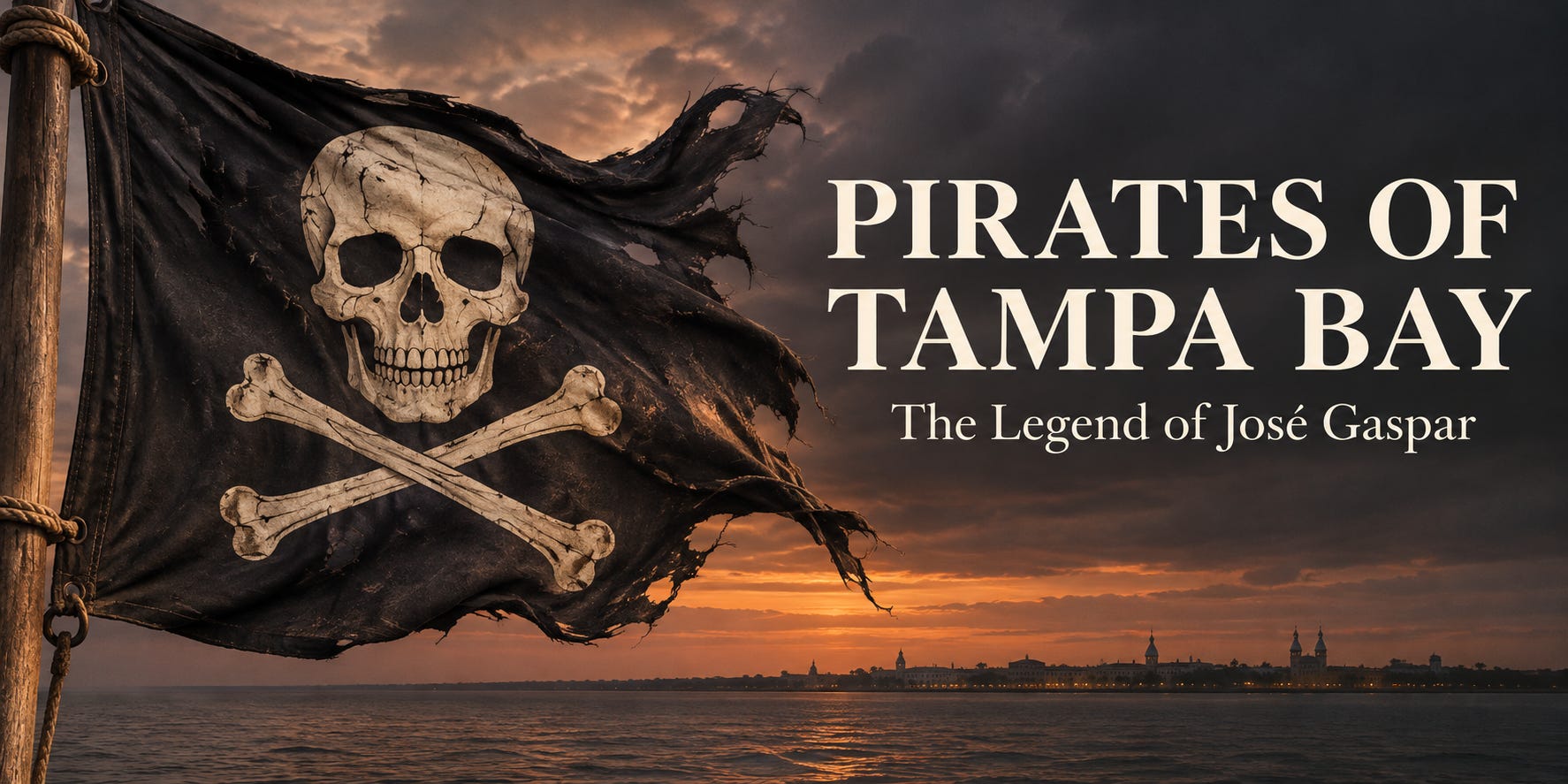
That question sent me in two directions. One took me back to a time when piracy and smuggling were real concerns for ships moving through the Gulf. The other led to the grounds of a Tampa hotel in 1904, where a group of people planning a May festival put on pirate costumes and climbed onto horses. I’d been looking at the wrong mode of transportation all these years. Gasparilla festival history
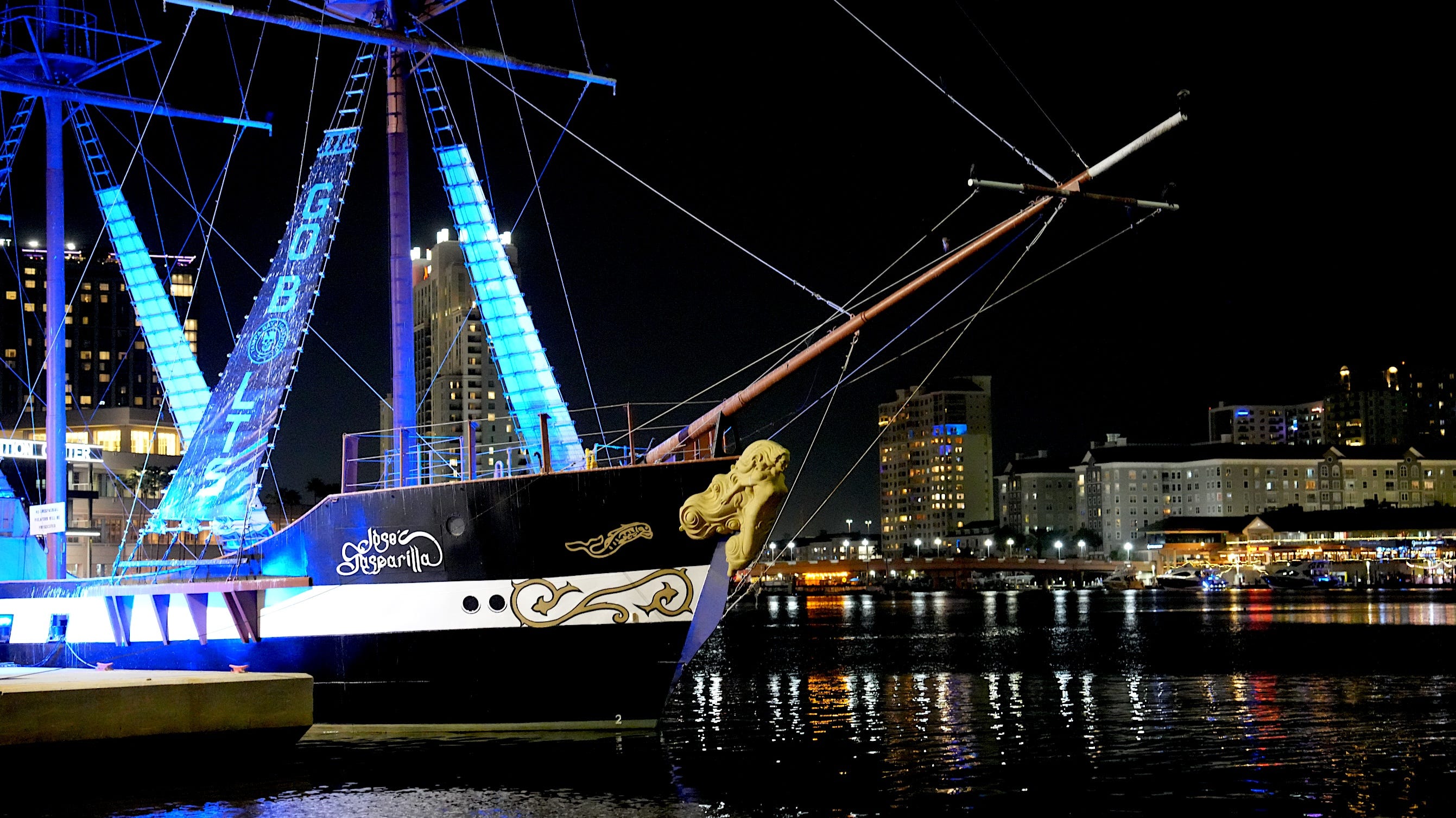
Blue lights trace the rigging of the José Gasparilla on the Tampa waterfront. Photograph by Mark Middleton.
What the Gulf’s pirates left behind
There really were pirates in the Gulf of Mexico, and you can see some of the evidence without ever leaving home. The National Archives has a handwritten letter in French from Jean Lafitte, preserved in the records of an 1820 federal court case involving a vessel called the Pegasus. The case is one of several connected to Jean and his brother Pierre, who were active in the Gulf in the early nineteenth century. The brothers claimed to be privateers, but federal authorities in New Orleans brought piracy charges. A few years before that letter became part of the court record, Jean had helped Andrew Jackson defend New Orleans against the British. He and his crew received pardons for earlier offenses. National Archives, Note from Jean Lafitte
That is a more complicated life than the one you’d give a villain in a pirate movie. The same man could be wanted by federal authorities and prove useful to the country whose laws he had broken. Even the distinction between a pirate and a privateer, which sounds straightforward until you start reading about the period, could depend on who claimed the authority to give a captain permission to seize a ship. The surviving records give historians something to work with. They can ask who issued that permission, who recognized it and what happened when a captured vessel came into port. National Archives, early federal court records on Gulf piracy
Lafitte’s paper trail tells us something about the world in which the Gaspar legend is set. It doesn’t place Lafitte in Tampa Bay. The geography matters here. When we say “the Gulf Coast,” we’re talking about a great sweep of shoreline, and a story with roots in Louisiana or around the southern tip of Florida can sound local by the time it’s retold in Tampa. The Gulf’s piracy was real. The evidence for a pirate based here, in the bay we’re looking at from Bayshore, is another matter. Rodney Kite-Powell of the Tampa Bay History Center points to documented activity elsewhere in Florida and the region, with no comparable record for the man Tampa celebrates. Bay News 9 interview with the Tampa Bay History Center
A good story travels
The legend puts José Gaspar along Florida’s west coast in the late eighteenth and early nineteenth centuries. In one familiar version, he was a Spanish naval officer who turned pirate, preyed on ships and kept captives at an island hideaway. The story ends around 1821, when a vessel he took for an easy prize turned out to be an American warship. Faced with capture, he wrapped himself in an anchor chain and went over the side. It’s a finely worked ending for a story told aloud. The man vanishes, and there’s still something left for the listener to wonder about. Captiva Island Historical Society, Gasparilla the Pirate
Much of the lore takes us to Charlotte Harbor and the islands around it, well south of Tampa Bay. There, the pirate story became attached to places you could visit. Boca Grande offered a good example of how this worked. A promotional account associated with the Charlotte Harbor and Northern Railway helped circulate the Gaspar legend in the early twentieth century, when the railroad and the resort had an interest in getting people down to the island. Imagine a visitor reading the story on the way to Boca Grande, then looking out at the islands and inlets the story had just made famous. It gave a traveler something to look for beyond the view from the hotel. André-Marcel d’Ans, The Legend of Gasparilla: Myth and History on Florida’s West Coast
The trouble comes when we try to follow the story back to Gaspar’s own lifetime. I could find accounts of what he supposedly did and evidence that people were telling the story many years later. I couldn’t find the equivalent of Lafitte’s letter, a record from his own time that would let us put Gaspar on a particular ship or in a particular harbor. Hillsborough County still presents his exploits as allegations and his existence as a matter of debate. By the time the story reached the people planning Tampa’s May festival, though, they had everything they needed. They had a name, a character and a coast their audience recognized. Hillsborough County, Faces Behind the Places: Jose Gaspar
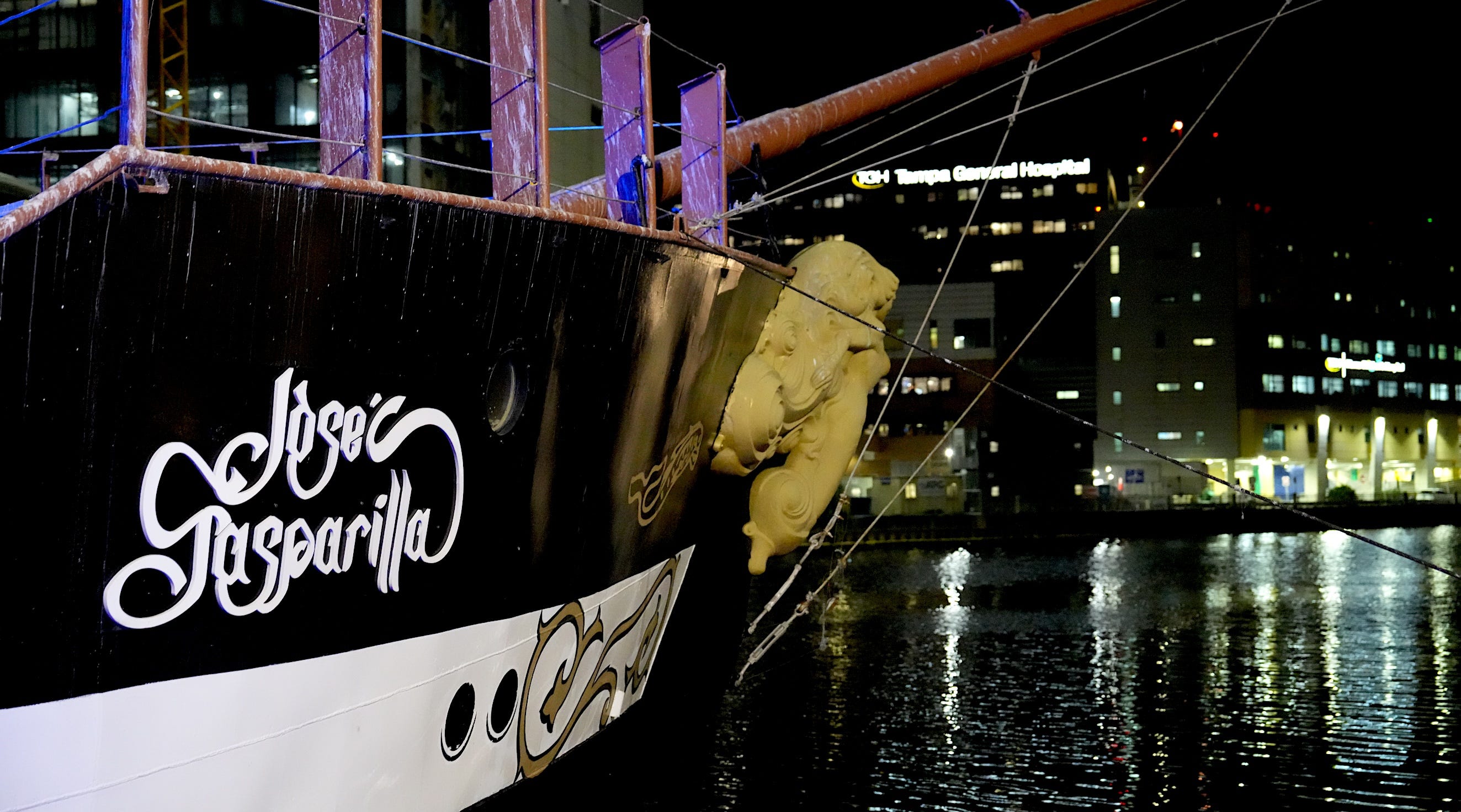
The painted name and gilded figurehead on the bow of the José Gasparilla. Photograph by Mark Middleton.
The first pirates came on horseback
If I were taking someone around Tampa to tell this story, I’d start across the river from downtown at the old Tampa Bay Hotel. Henry Plant opened it as a winter resort in 1891. Today it’s Plant Hall at the University of Tampa, and you can still walk up to the brick facade, stand beneath the veranda and look up at the silver minarets. The building gives you some sense of what Tampa wanted people to see when they arrived. Plant had built a resort with a presence well beyond the city, and its grounds gave Tampa a place to stage a celebration that visitors would remember. Henry B. Plant Museum chronology
In 1904, Mary Louise Dodge, the Tampa Tribune’s society editor, was helping plan the city’s May festivities when George Hardee suggested using the Gasparilla legend. It was a practical idea. Tampa wanted to draw people to the celebration and give them a reason to stay. The pirate gave the festival a story people could follow, and the organizers could turn that story into a public performance. The first invasion began in Plant Park, and the coronation ball took place in the hotel dining room. According to the festival’s history, those first pirates arrived on horseback. The krewe first staged an invasion by ship in 1911. Gasparilla festival history · Henry B. Plant Museum chronology
I’d gone to photograph the hotel for its minarets, but once I knew where the first invasion began, I kept coming back to the veranda and the grounds below it. Try standing there and picturing the arrangements for that day. Someone had to bring the horses, tell the costumed riders where to gather and give the spectators a place to watch. Later there would be a ball in the dining room. You could have spent the entire day at the first Gasparilla without seeing a pirate ship.
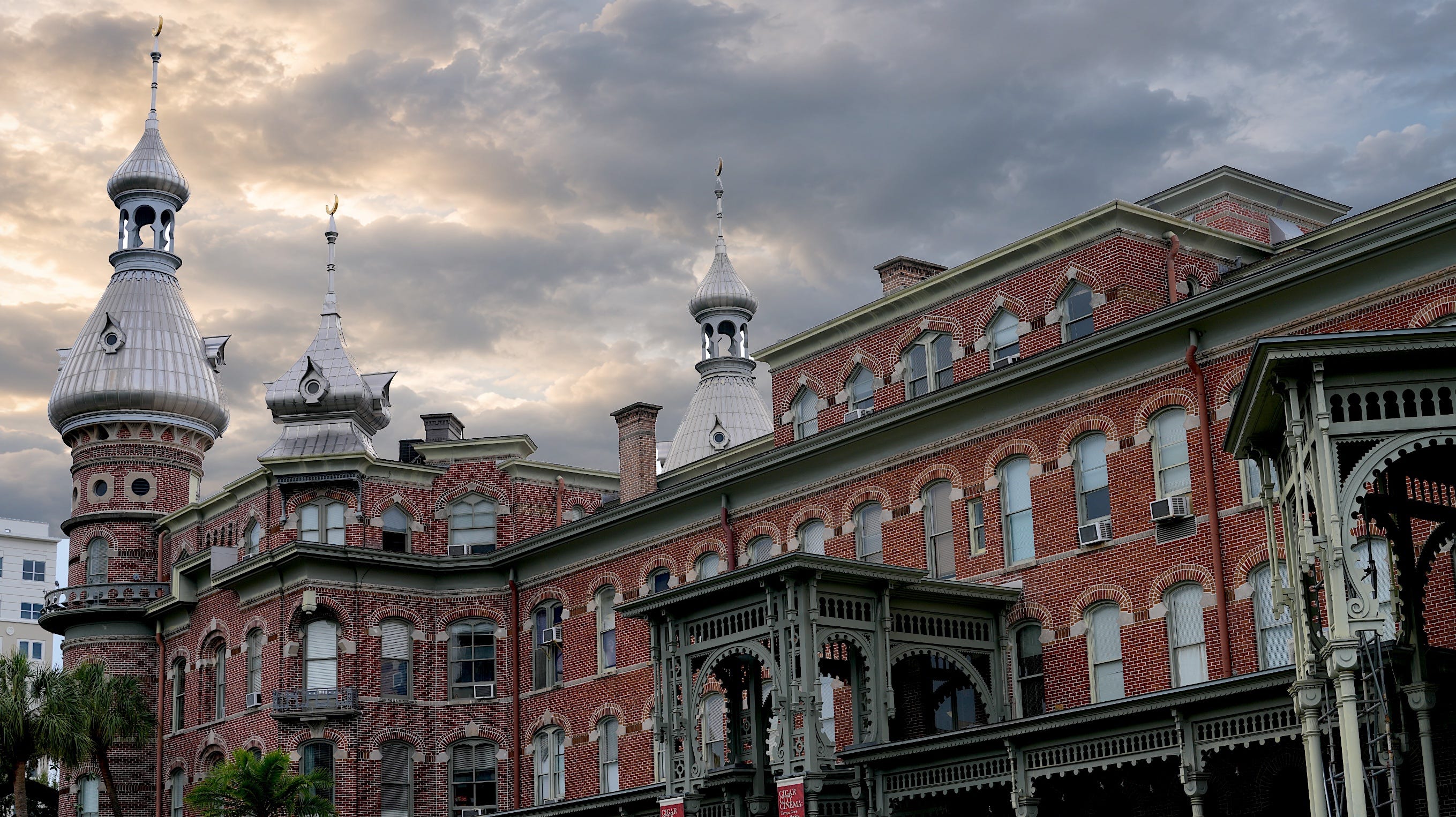
The veranda and minarets of the former Tampa Bay Hotel, now Plant Hall at the University of Tampa. Photograph by Mark Middleton, with a replacement sky.
When the invasion moved onto the water
Coming by ship changed what the people on shore could see. A procession on horseback can appear as soon as it rounds a corner. A ship gives itself away a long way off. You have time to pick it out, point it out to the person next to you and watch the other boats fall in around it. For a city built around its relationship to the water, staging the arrival that way gave Tampa something it could make its own.
Even then, it took decades to arrive at the ship we recognize today. The krewe began using its first owned vessel in 1937, and the José Gasparilla II debuted in 1954, for the festival’s fiftieth anniversary. There’s another detail in the festival chronology that caught my eye. The ship sailed up the Hillsborough River on invasion day for the last time in 1975, when the Crosstown Expressway was completed. A change in the city’s infrastructure changed the route of the pirates. If you grew up with an older version of Gasparilla, where you remember seeing the ship may be different from where someone younger would think to look for it. Gasparilla festival history
It was still a Monday event when I moved here in 1984. It moved to Saturday in 1988. In 2001, the invasion and parade shifted to the last Saturday in January to coincide with the Super Bowl. Those dates made me realize how readily I think of Gasparilla as something Tampa has always done the same way. In the time I’ve lived here, the day of the week changed and then the date changed. Go back a little further and you find the ship taking a route it no longer takes. Go back to the start and you find the horses. Gasparilla festival history
There were also harder questions about whose celebration it was. In 1991, amid pressure to integrate the all-white host krewe, the krewe canceled its parade. That happened in the Tampa I’d already moved to, only a few years after the parade went to Saturdays. I think it belongs in the history alongside the ships and the route changes. If a city presents a celebration as its own, people have a right to ask who gets to take part and who gets to make the decisions. It’s easy to look at a festive photograph from any era and see only the people who were invited into the frame. Bay News 9, the history of Gasparilla krewe integration
Back to the bay
For the last photograph, I went looking for a view of the water in daylight. In the picture, the Bayshore balustrade cuts across the foreground, downtown sits low on the horizon, and the clouds get most of the frame. You can see how far away the city looks from the curve of the shore. On invasion day the distance is part of the pleasure. The ship takes time to come into view, and for a few minutes a lot of people who don’t know one another are watching the same patch of water.
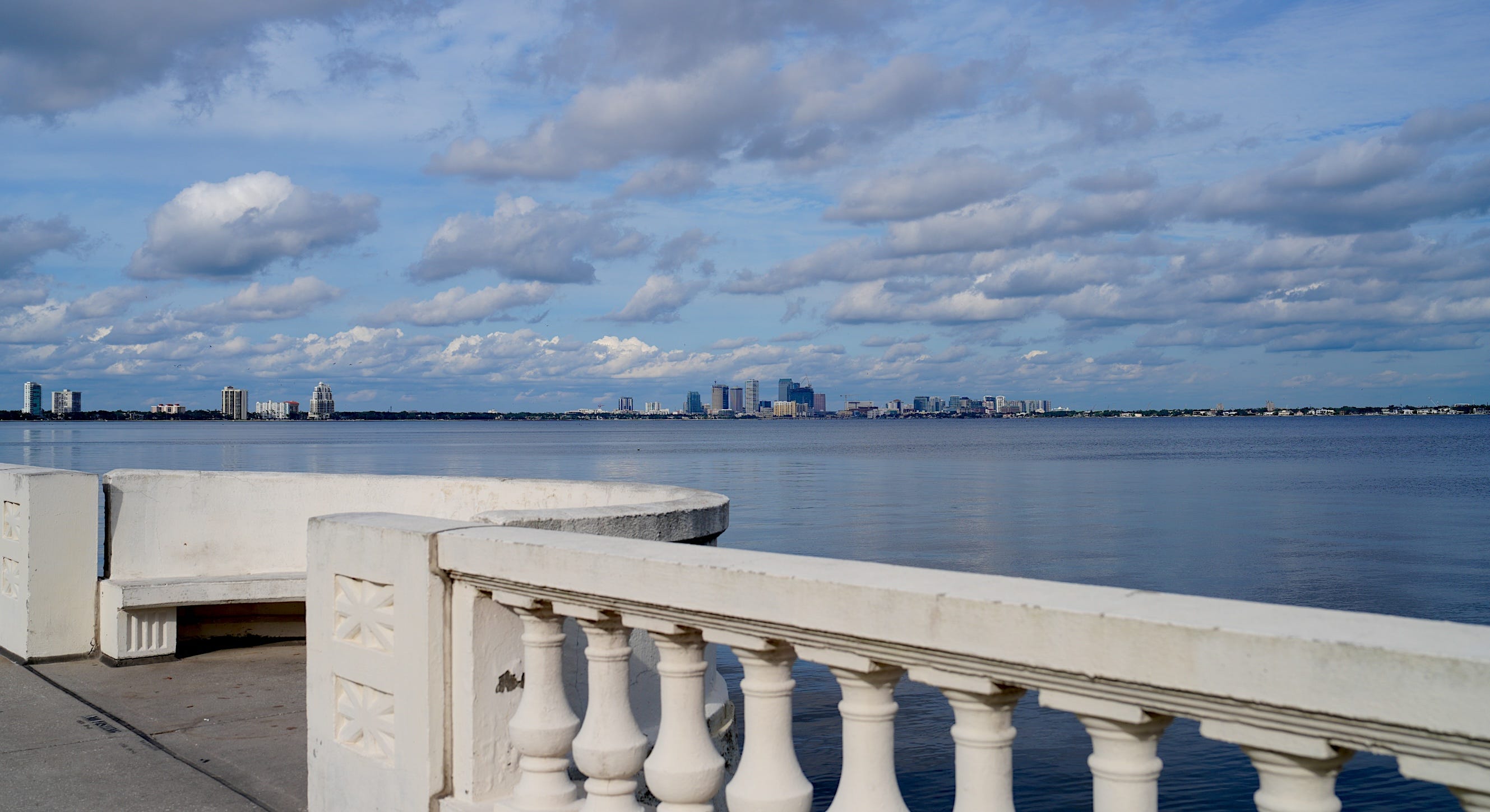
Looking across Hillsborough Bay toward downtown Tampa. Photograph by Mark Middleton.
I started with the question of whether there really were pirates out there. There were pirates in the Gulf, and some of them left enough evidence for us to trace their lives. José Gaspar is still elusive. The people I can follow with some confidence are the ones who borrowed his story for a May festival, the ones who eventually took it out onto the water and the ones who kept showing up as Tampa changed around them.
The next time I’m down on Bayshore and see the José Gasparilla coming toward downtown, I’ll still look for the figurehead and the name on the bow. But I’ll also be thinking about that first crowd in Plant Park. They’d come out for a spring festival, with the hotel behind them and the river nearby. Then somebody must have looked down the way and seen the horses coming.
I write these articles because even after all these years in Tampa Bay, a place I’ve passed a hundred times can still send me home with a question. Taking a photograph often gets me started, and finding out who built a place or what happened there gives me a reason to go back. If you’d like to follow Henry Plant’s story across the river, I’ve written about the history of Hyde Park at Historic Homes Tampa Bay. You can also find more of my photography at MarkAMiddleton.com and more stories from closer to home at Discover Delightful Dunedin.